


Two rooms, one week. Same pattern.
The first was a pitch event in Palo Alto. Sixteen early-stage startups. Half had revenue. Every single one had a real product. Almost none had a repeatable GTM motion.
The second was an AWS Builder meetup in San Francisco. SurrealDB was presenting their agent memory platform. Technically brilliant. At the Q&A, I asked the Co-founder Tobie, a straightforward question.
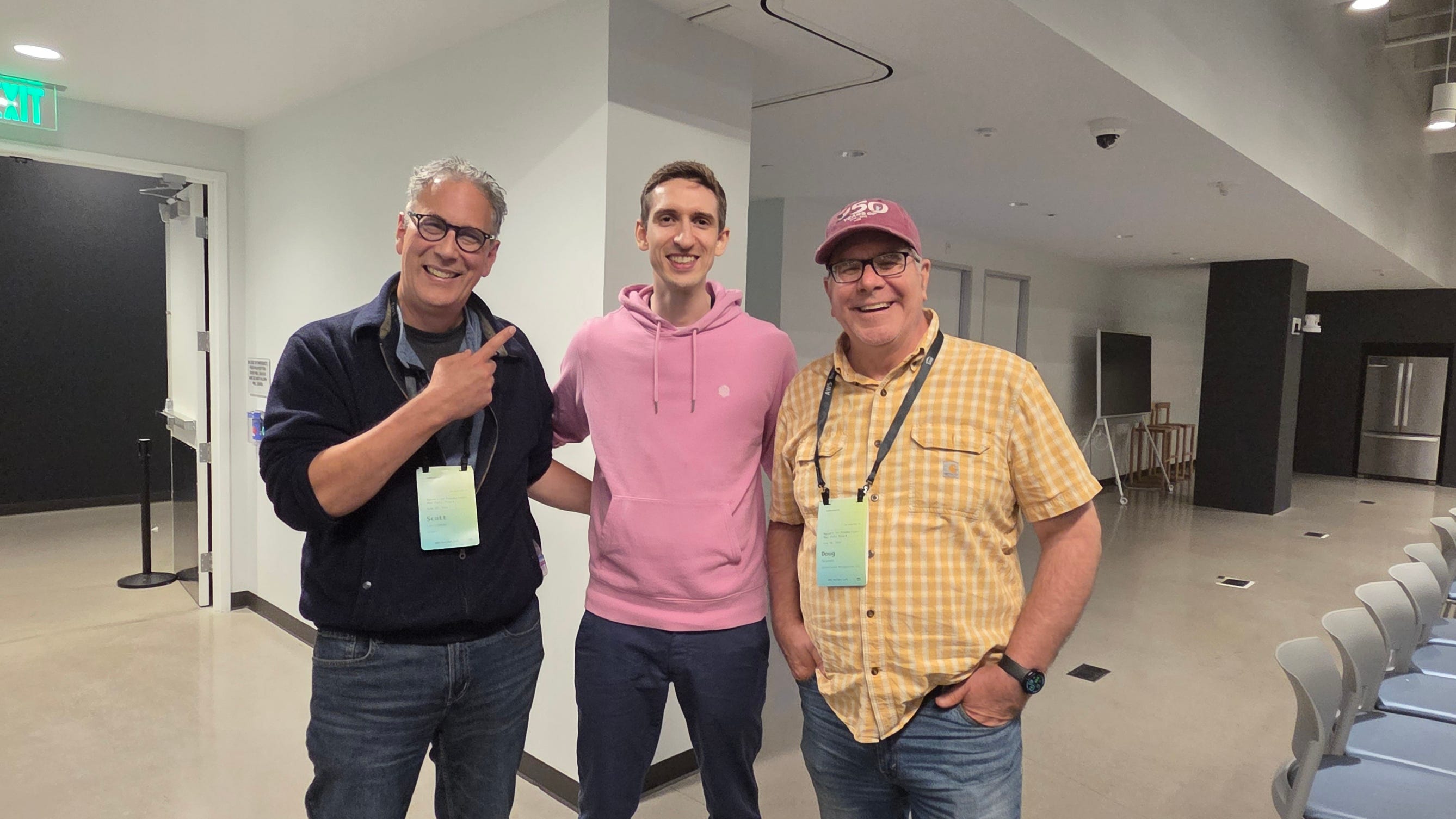
“Over the next twelve to twenty-four months, who are you actually targeting? Developers, AI-native startups, enterprise, database consolidation?”
The answer: all types of organizations. Startups, scale-ups, enterprises, defense, finance.
Honest answer. Expensive answer.
The Gap Mark Roberge Keeps Warning Founders About
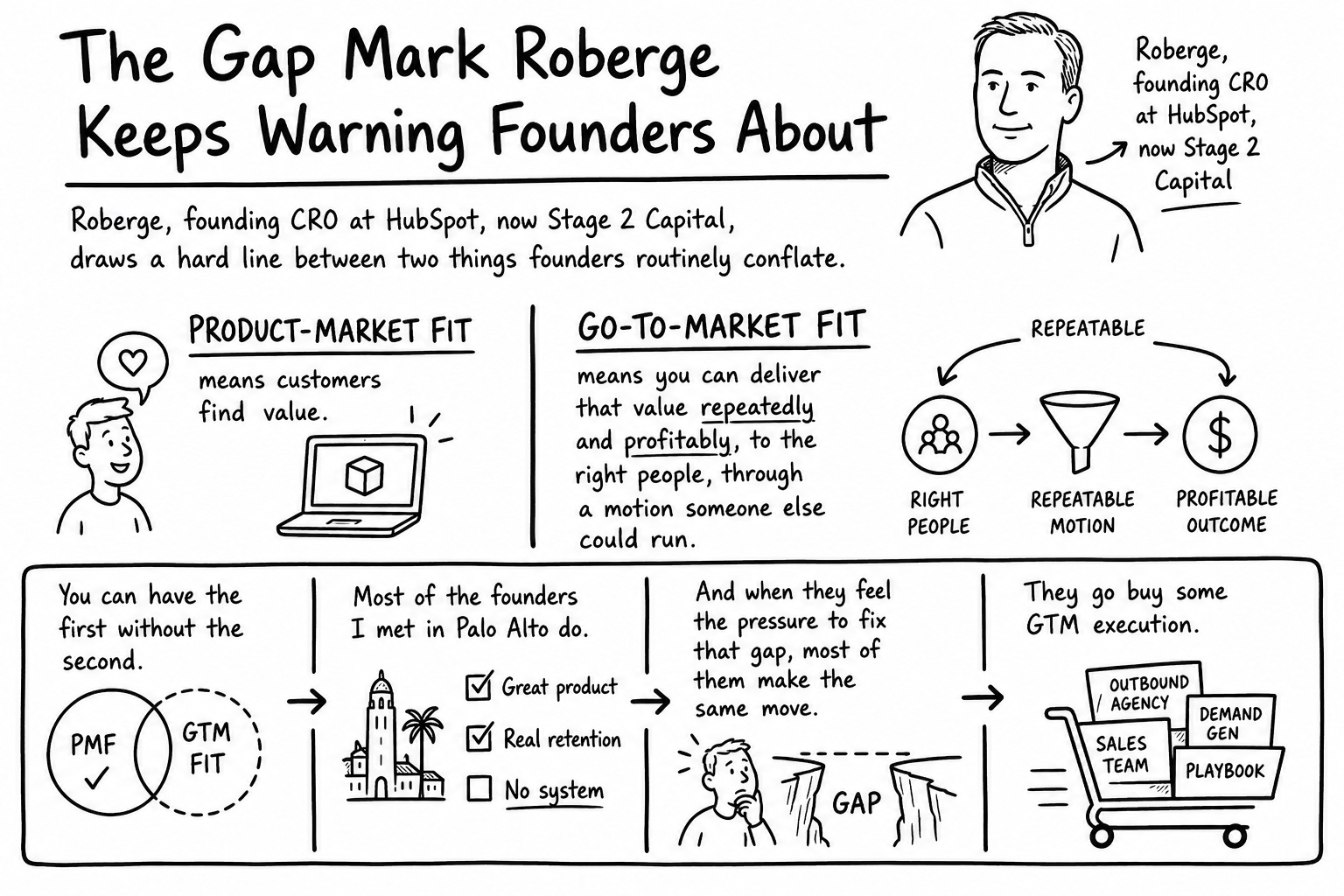
Roberge, founding CRO at HubSpot, now Stage 2 Capital, draws a hard line between two things founders routinely conflate.
Product-market fit means customers find value. Go-to-market fit means you can deliver that value *repeatedly and profitably*, to the right people, through a motion someone else could run.
You can have the first without the second. Most of the founders I met in Palo Alto do. Great product. Real retention. No system.
And when they feel the pressure to fix that gap, most of them make the same move.
They go buy some GTM execution.
Three Ways Founders Try to Buy GTM
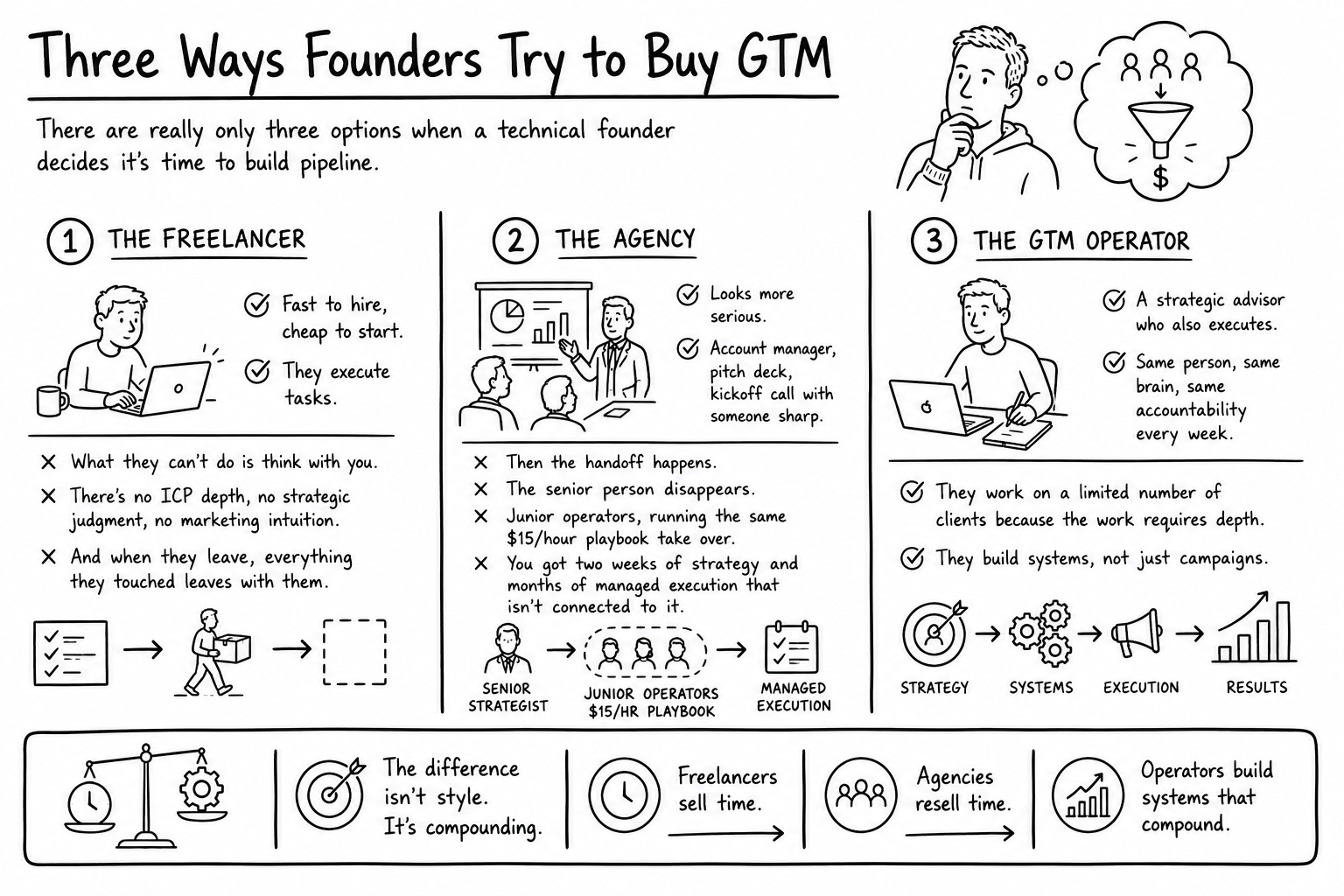
There are really only three options when a technical founder decides it’s time to build pipeline.
**Option 1: The Freelancer.** Fast to hire, cheap to start. They execute tasks. What they can’t do is think with you. There’s no ICP depth, no strategic judgment, no marketing intuition. And when they leave, everything they touched leaves with them.
**Option 2: The Agency.** Looks more serious. There’s an account manager, a pitch deck, a kickoff call with someone sharp. Then the handoff happens. The senior person disappears. Junior operators, running the same $15/hour playbook take over. You got two weeks of strategy and months of managed execution that isn’t connected to it.
**Option 3: The GTM Operator.** A strategic advisor who also executes. Same person, same brain, same accountability every week. They work on a limited number of clients because the work requires depth. They build systems, not just campaigns.
The difference isn’t style. It’s compounding.
Freelancers sell time. Agencies resell time. Operators build systems that compound.
Why the First Two Options Don’t Solve the Actual Problem
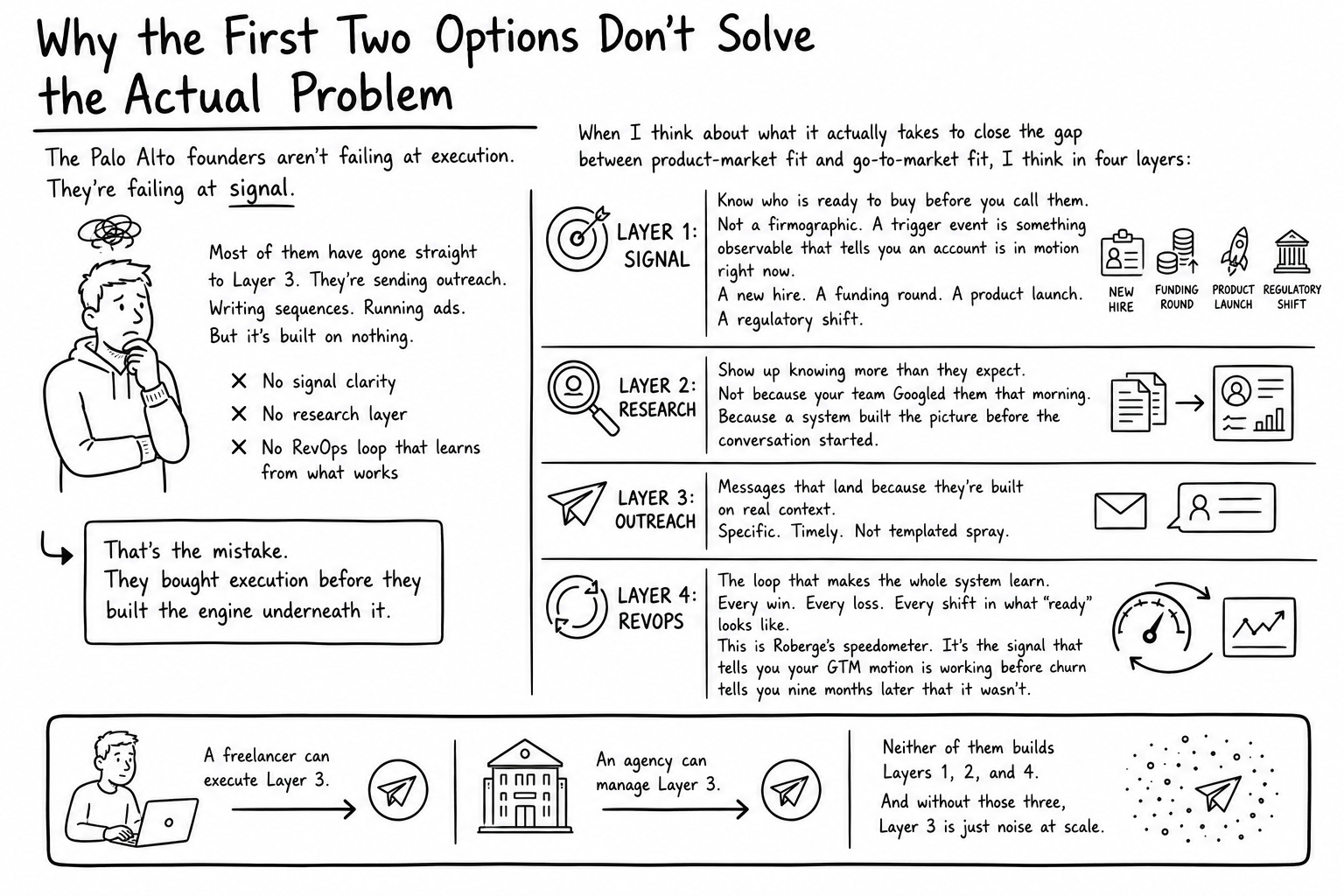
The Palo Alto founders aren’t failing at execution. They’re failing at *signal*.
Most of them have gone straight to Layer 3. They’re sending outreach. Writing sequences. Running ads. But it’s built on nothing. There’s no signal clarity, no research layer, no RevOps loop that learns from what works.
That’s the mistake. They bought execution before they built the engine underneath it.
When I think about what it actually takes to close the gap between product-market fit and go-to-market fit, I think in four layers:
**Layer 1: Signal.** Know who is ready to buy before you call them. Not a firmographic. A trigger event is something observable that tells you an account is in motion *right now*. A new hire. A funding round. A product launch. A regulatory shift.
**Layer 2: Research.** Show up knowing more than they expect. Not because your team Googled them that morning. Because a system built the picture before the conversation started.
**Layer 3: Outreach.** Messages that land because they’re built on real context. Specific. Timely. Not templated spray.
**Layer 4: RevOps.** The loop that makes the whole system learn. Every win. Every loss. Every shift in what “ready” looks like. This is Roberge’s speedometer. It’s the signal that tells you your GTM motion is working before churn tells you nine months later that it wasn’t.
A freelancer can execute Layer 3. An agency can manage Layer 3. Neither of them builds Layers 1, 2, and 4. And without those three, Layer 3 is just noise at scale.
What the Right Model Actually Produces
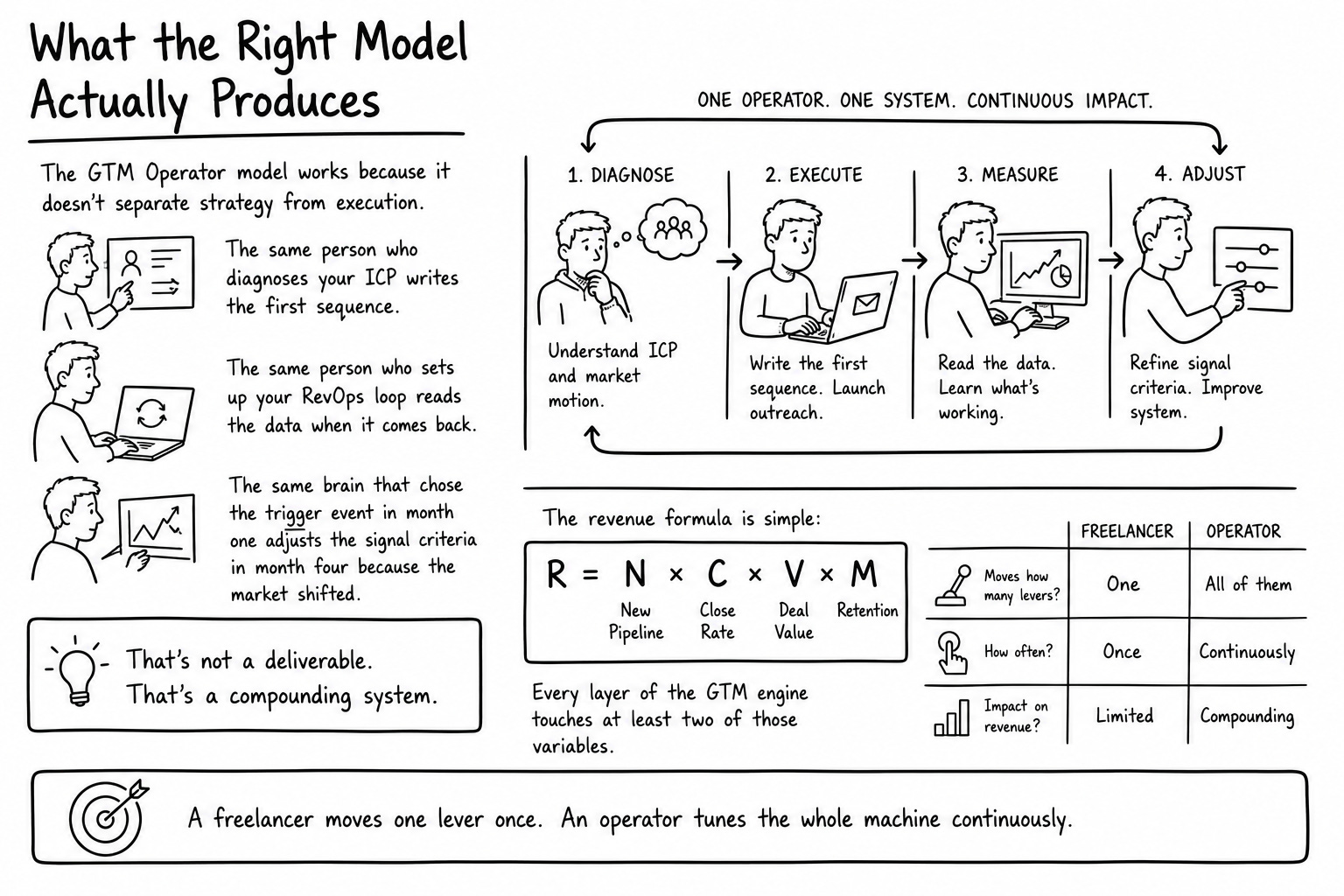
The GTM Operator model works because it doesn’t separate strategy from execution.
The same person who diagnoses your ICP writes the first sequence. The same person who sets up your RevOps loop reads the data when it comes back. The same brain that chose the trigger event in month one adjusts the signal criteria in month four because the market shifted.
That’s not a deliverable. That’s a compounding system.
The revenue formula is simple: R = N × C × V × M. New pipeline times close rate times deal value times retention. Every layer of the GTM engine touches at least two of those variables. A freelancer moves one lever once. An operator tunes the whole machine continuously.
The Question That Tells You Where You Are
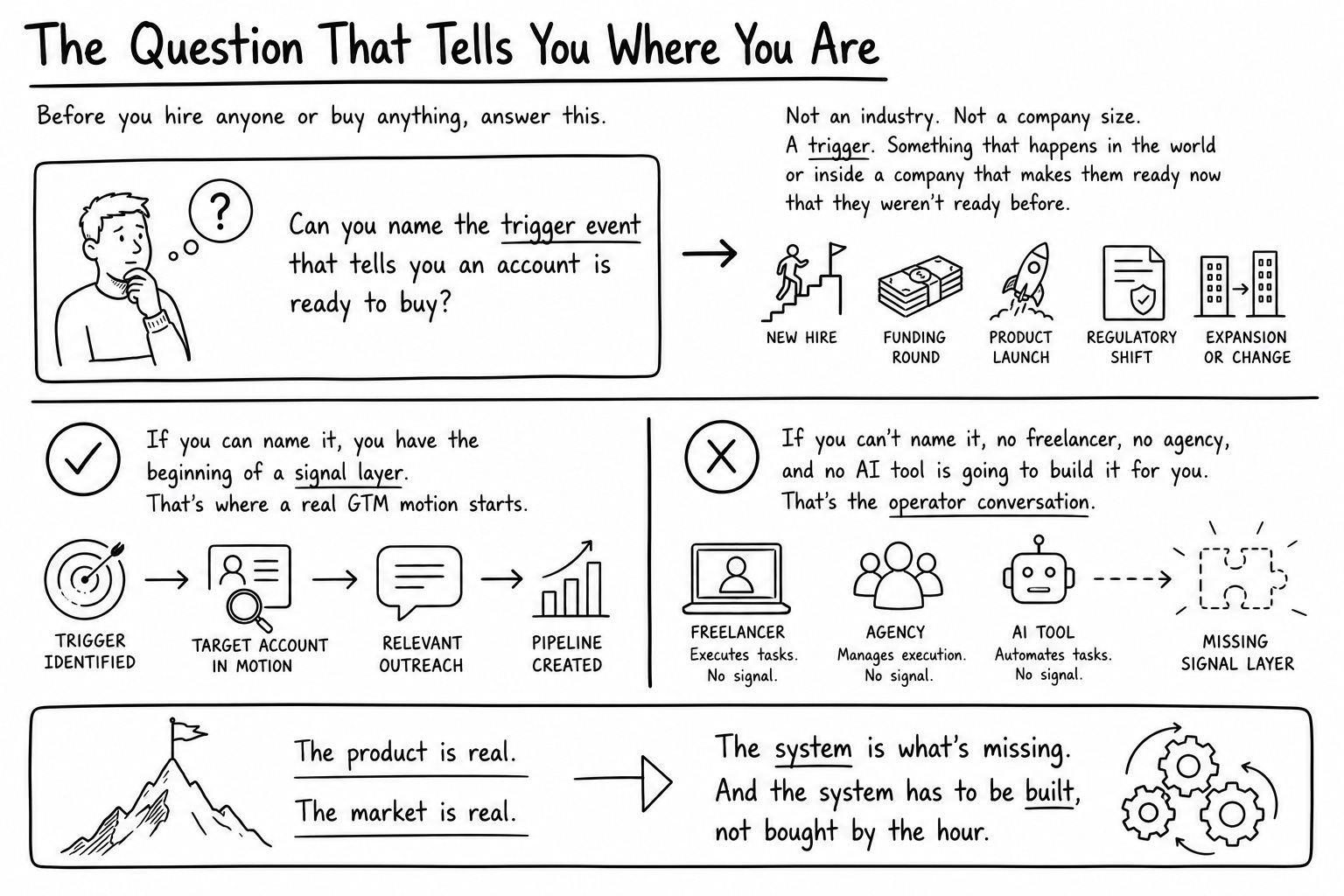
Before you hire anyone or buy anything, answer this.
Can you name the trigger event that tells you an account is ready to buy?
Not an industry. Not a company size. A *trigger*. Something that happens in the world or inside a company that makes them ready now that they weren’t ready before.
If you can name it, you have the beginning of a signal layer. That’s where a real GTM motion starts.
If you can’t name it, no freelancer, no agency, and no AI tool is going to build it for you. That’s the operator conversation.
The product is real. The market is real.
The system is what’s missing. And the system has to be built, not bought by the hour.
*If you’re a founder or know one building this right now, I’d start with the trigger. What event makes your best customers ready? Hit share.*