


Four strangers built a working product in two hours.
A product manager. A marketer. A founder I talk with regularly. And a guy who flew from Germany to San Francisco on vacation, for the sole purpose of attending hackathons.
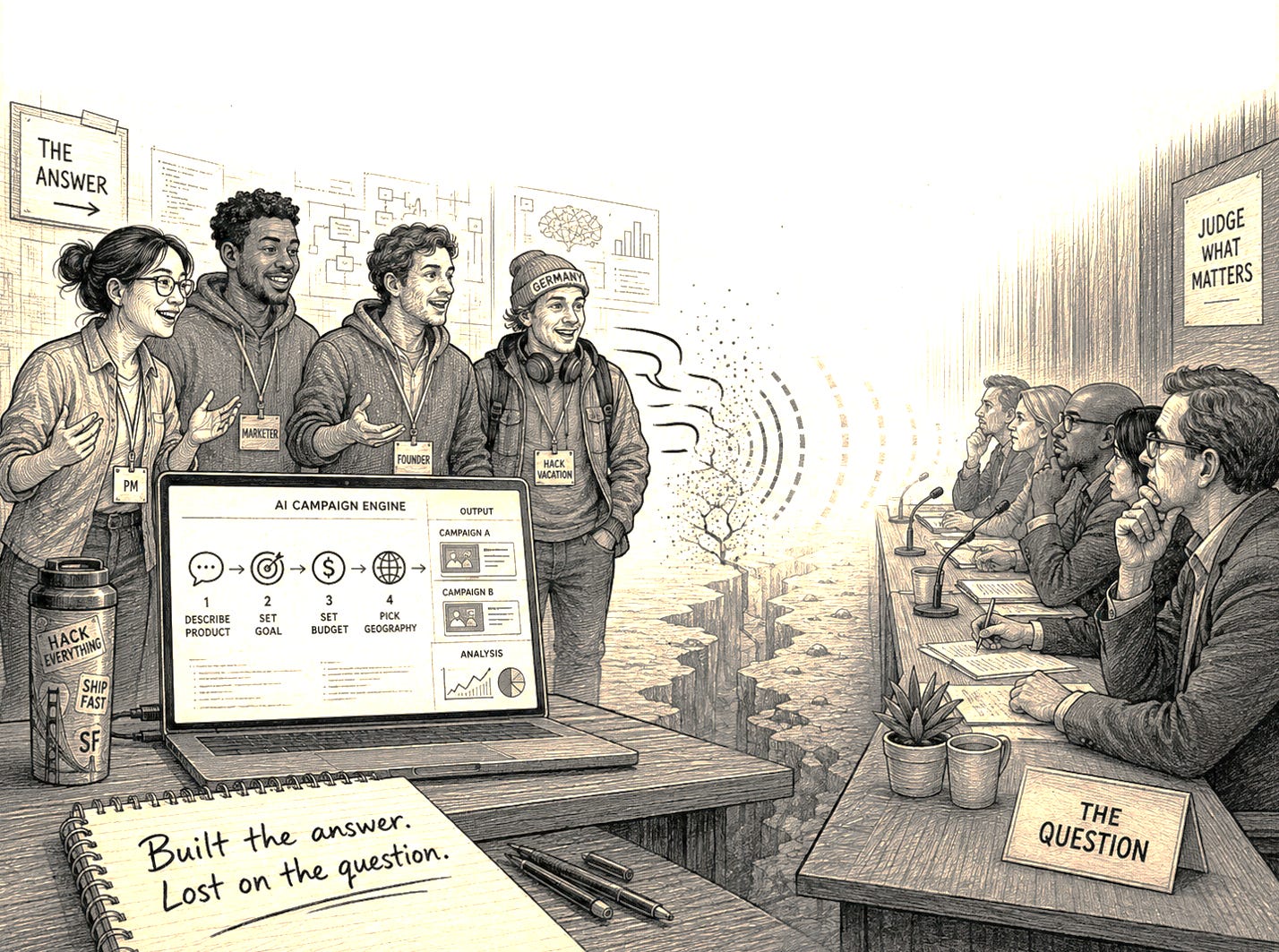
They shipped an AI campaign engine. Describe your product. Set a goal. Set a budget. Pick a geography.
It returned two campaign variants, ran synthetic A/B metrics, and delivered an analysis. Work that used to take two weeks and a real ten thousand dollar spend.
Then the jury gave its feedback.
They did not say the build was bad. They said this:
You didn’t present the problem. You didn’t share the value prop well enough.
He built the answer and lost on the question.
Thanks for reading my summer of 2026 point of view and making comments. I am listening to you with the intent to better understand what helps you as a founder move forward, remaining in the ‘eye of the AI storm’.
The line that explains the whole summer
That same founder told me something a few weeks later that I have not been able to put down.

He was describing why his first launch failed. Two clients, both stalled, nobody adopting.
He said: “We weren’t building for the customer. We were building for the investor.”
That is the founder condition in 2026, stated more honestly than most of us manage.
You are building for the room that funds you. Not the room that buys from you.
AI just made that mistake much cheaper to commit, and much more expensive to survive.
What I actually watched
I spent the last five weeks in rooms.
AMD at Moscone. AWS Launchpad and the AWS Builder AI Camp. (Open) ClawCamp and Claude Camp. A Cerebras launch. TailscaleUp. A Provectus-Anthropic workshop on agentic work. Roundtables, founder calls, hackathon debriefs.
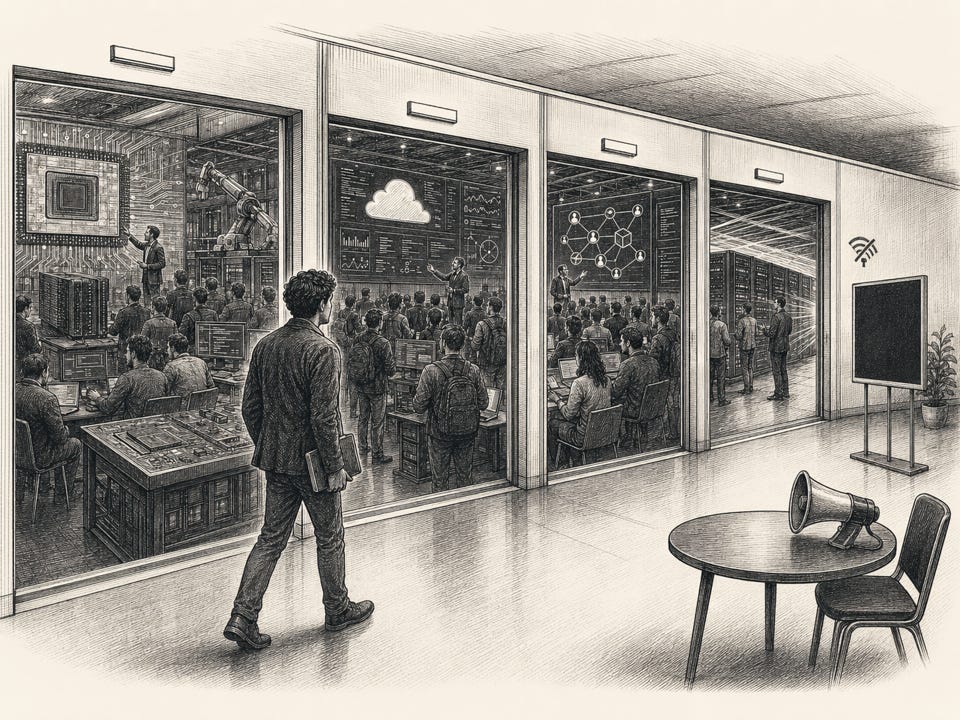
The exposure for me was extraordinary. Inference providers serving forty trillion tokens a day. Context compression cutting token usage by eighty-three percent. Six hundred megawatts of new data center capacity. Agent memory graphs. A company brain.
Here is what almost none of it had on the agenda.
Distribution.
Very few rooms asked how any of this reaches a buyer.
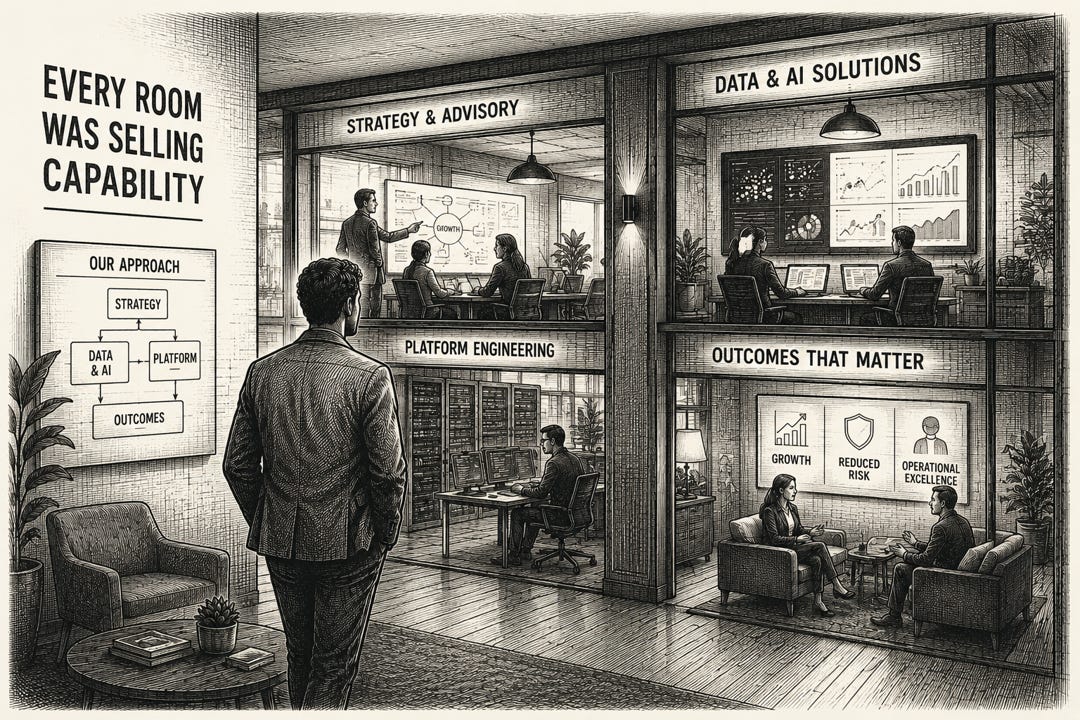
Every room was selling capability
That is the pattern. Nearly every session, every booth, every demo.
Faster tokens. Cheaper inference. Longer context. Better agents. More capability.
Capability is real. Capability is also now table stakes.
Let me make it concrete.
This summer I built my son a five page booking site on Vercel. Coaching schedule, payments, appointments. One day. Nothing to host.
A couple years ago I would have charged a client five thousand dollars for that build.
The wall did not get lower. The wall came down.
When a wall comes down, everyone standing behind it becomes visible at the same moment. Visible, and suddenly identical.
That is your feed right now. Four hundred founders, all newly capable, all saying the same sentence about what they built.
Capability stopped being your differentiator the moment it became free. It became the noise.
And your capability window is closing faster than you think
On August 26, Marc Benioff and Dario Amodei sat down together to launch a joint product. The largest CRM on the planet, wired directly to a frontier lab.
Read that as a founder, not as a spectator.
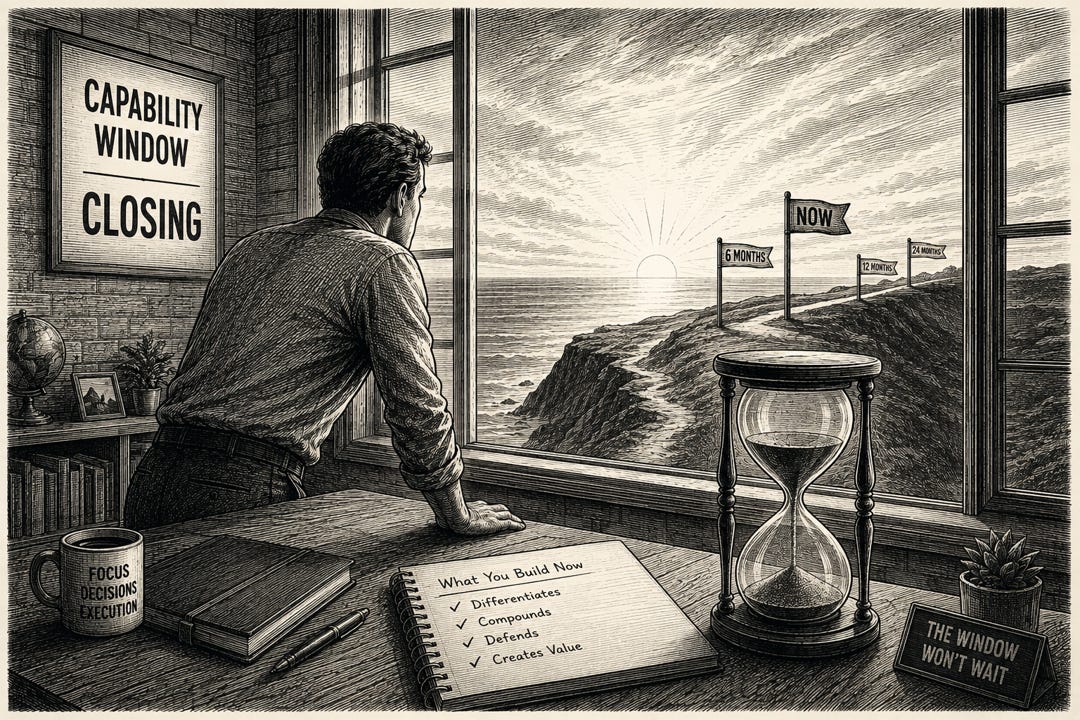
Whatever capability you are currently differentiating on has a shelf life. The platform layer absorbs features. It always has. AI just compressed the absorption cycle from years to weeks.
You cannot win a race where your competitor’s roadmap ships as someone else’s default setting.
So stop racing on capability. Race on the thing platforms cannot absorb, which is knowing something specific and current about a specific buyer.
The best idea I heard all month came from a networking talk
At the AWS Builder AI Camp, a LangChain engineer demoed eight agents triaging a service incident.
No central coordinator. No orchestrator telling anyone what to do.
The agents coordinated by leaving traces in a shared document. Each one read what had changed, decided whether it had something to contribute, and acted. Biologists call this stigmergy. Ants do it. It works at scale precisely because nobody is broadcasting.

I sat there thinking: that is the market.
Your buyers are not waiting for your announcement. They are leaving traces. Funding rounds. Job requisitions. Filings. A public complaint about the exact friction you remove.
Broadcasting is the old model, and the old model assumed attention was available. It is not available anymore.
Read the traces. Act on the ones that concern you. Stay quiet on the rest.
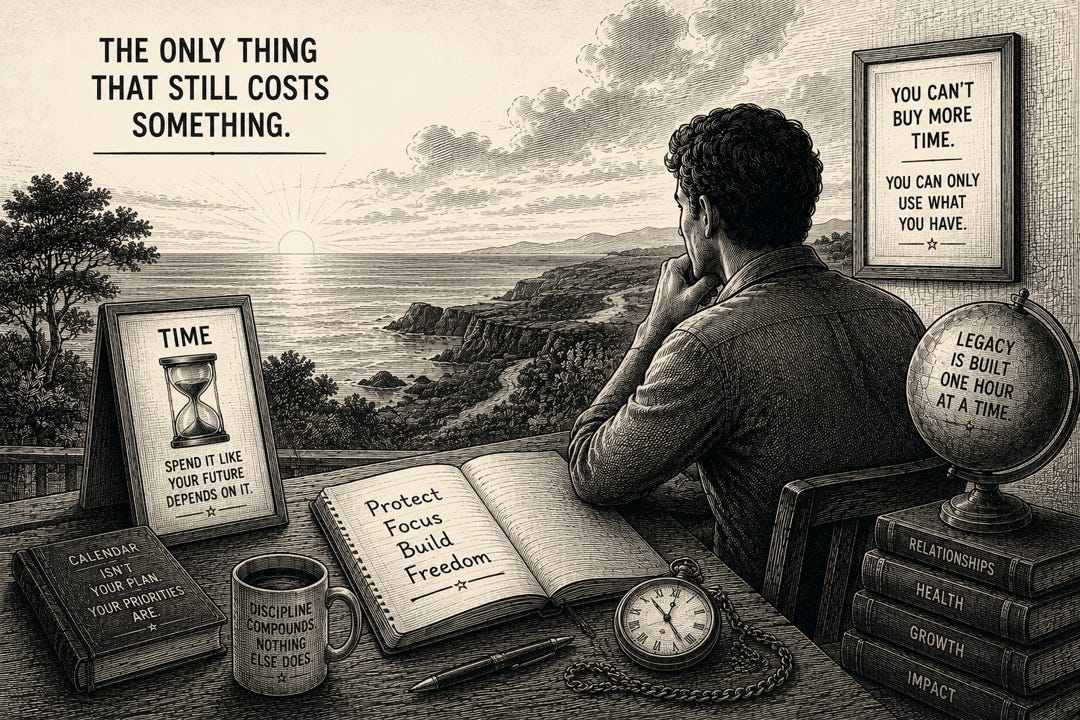
The only thing that still costs something
Proof of trigger.
Evidence that a specific buyer, at a specific moment, has a specific reason to move.
Not a claim about your product. A signal about their week.
That is the scarce asset, and it is scarce because it cannot be generated. It has to be observed.
Here is what that looks like inside the four layer AI Orchestration motion.
Signal. Stop buying lists. Start watching changes. One platform I build with targets profiles from job postings, social activity, and regulatory filings rather than from a static database. That is the direction of travel.
Research. Volume is a cost, not a virtue. Put a cheap model in front of your expensive one and let it discard the irrelevant before you pay for reasoning. And note this: most of your target accounts post rarely. They comment far more often. The comment layer is under-fished.
Outreach. Open with the trigger you saw. Name it. Date it. Source it. Then, and only then, name what you do. The order is not a stylistic choice. The order is the entire thing.
RevOps. This is the layer founders skip and buyers do not. More on that in a moment.
Three ways your signal dies
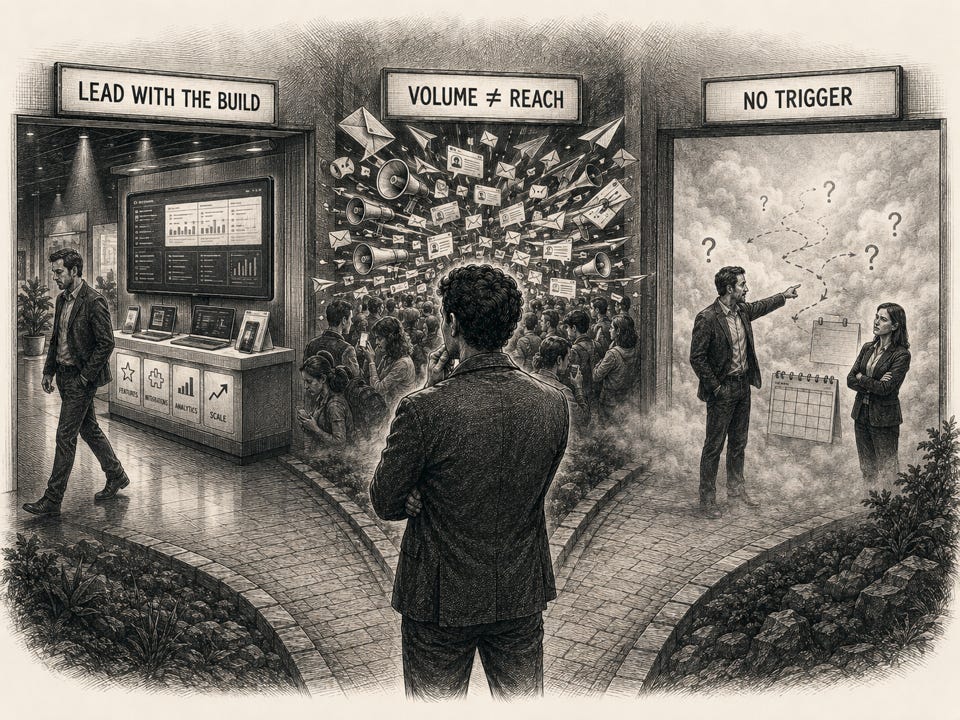
One. You lead with what you built.
Your buyer does not have a capability gap. They have a moment. Open with capability and you are one of four hundred capability claims competing for the same three seconds.
Two. You confuse volume with reach.
More posts. More sends. More sequences. AI made your output free, which means it made everyone’s output free. The feed did not expand to accommodate you. Your share of it shrank.
Three. You cannot name the trigger.
You do not know what changed in their world this week. So you sound speculative.
Speculative sounds like noise. Noise gets deleted.
How the good demos actually talked
At that same AWS session, an engineer walked through a supply chain deployment at a large pharmaceutical company.
He did not open with durable memory or virtual file systems, though the system has both.
He opened with this. Report generation went from twelve weeks to ten minutes. Eight million dollars saved a year.
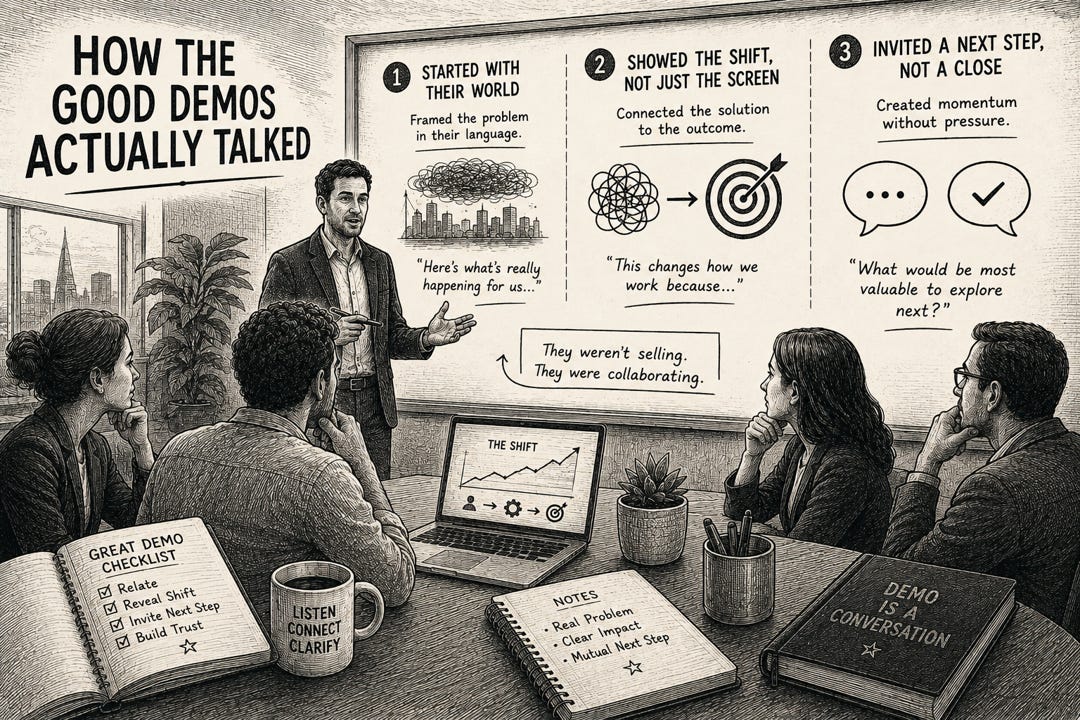
Twelve weeks to ten minutes. That is a sentence a CFO repeats in a meeting you are not in.
Compare it to how most founders open. “We built an agentic platform with persistent context.”
Same technology. One of those sentences travels. The other one dies in the room it was spoken in.
Name the outcome. Let them ask how it works.
The layer that closes your deals, and you are ignoring it
Founders treat governance as the boring part. Buyers treat it as the buying part.
Gartner predicted that forty percent of enterprise applications would feature task-specific AI agents by 2026, up from less than five percent in 2025.
Now put that next to what security leaders are actually reporting. In the 2026 CISO AI Risk Report from Cybersecurity Insiders and Saviynt, seventy-one percent of organizations said they use AI tools that reach into core business systems like Salesforce and SAP. Only sixteen percent said they effectively govern that access.
Sit with that gap. Your buyer wants what you built and is not equipped to absorb it.
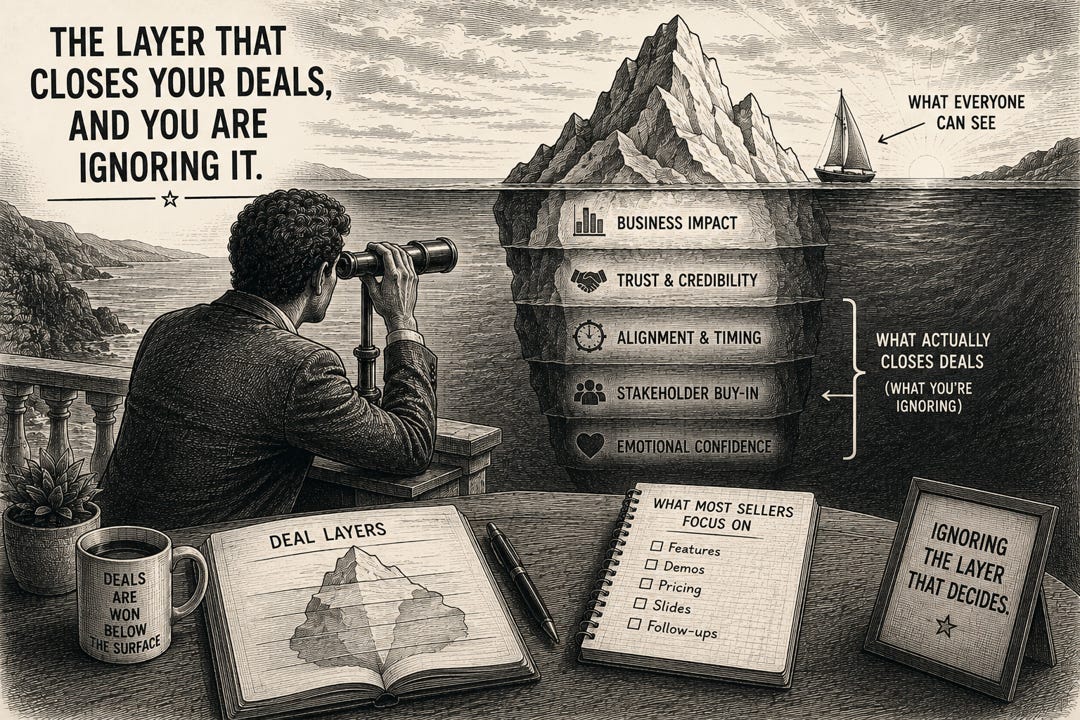
That is not a footnote. That is the objection that kills your deal in procurement, three weeks after your champion said yes.
The vendors in the room already know this. AWS spent a chunk of its builder session on the governance layer underneath its agent stack. Tailscale shipped secure credential injection so agents never touch a raw secret. The infrastructure companies are selling control, not just capability.
And here is the specific ask I keep hearing from executives, in almost the same words every time.
They want a red button.
A control that says stop before this burns my token budget. Predictable cost. A kill switch. Someone accountable for what the agent did and why.
If you cannot show cost containment, you are asking a buyer to sign an open ended invoice. No serious operator does that.
Build the guardrail into the offer. It is not a compliance cost. It is a closing tool.
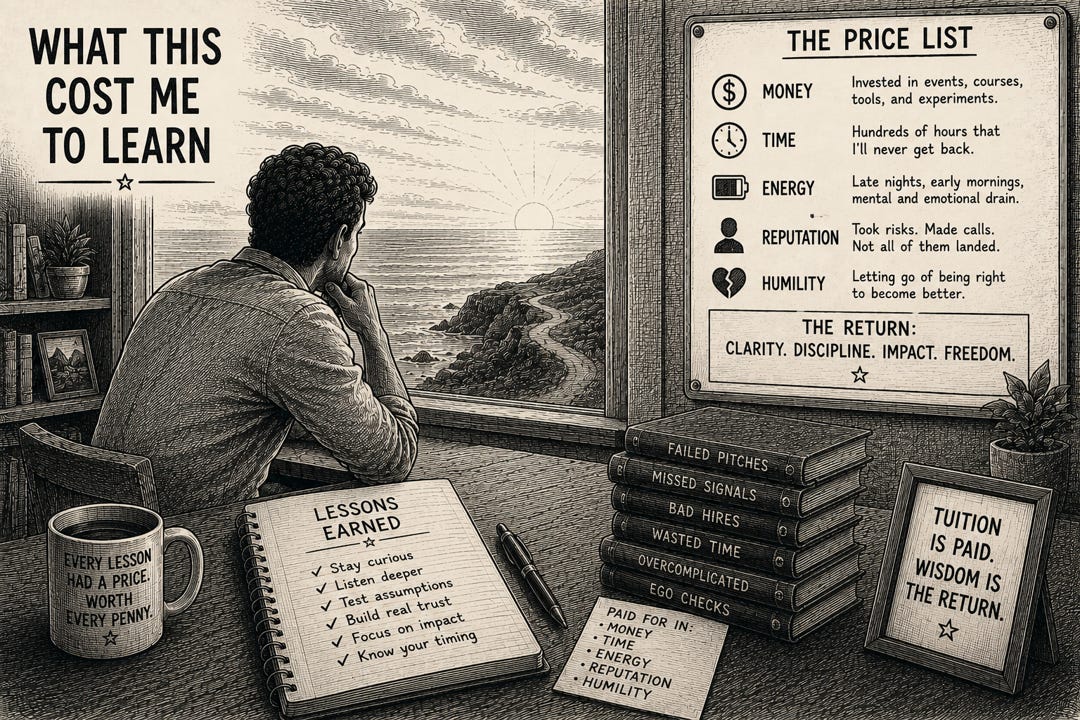
What this cost me to learn
I lost a deal this summer.
A VP of sales running a million dollar personal book. Opening a branch. He needed a prospector, and he told me so directly.
I knew the problem. I had done the job the system was supposed to do. I had the architecture spec’d and I could build it.
I still lost.
Not because the build was wrong. Because I opened with a picture instead of with his trigger, and the picture landed sideways before I ever got to explain it.
He still has the problem. That is the part that stings.
I made him do the translation work. Buyers do not do the translation work. They just stop replying.
What changed when I fixed the order
I stopped leading with capability. I started leading with the trigger.
Since then: two new engagements signed, both on this exact motion.
GTMSOS went from scattered pages to an actual system. The domain is live. Twelve child pages. A product architecture that holds together.

The 100 Leads Sprint got designed and built end to end with a development partner. Signal capture, model scoring, structured data, all wired.
And an invitation to speak at an AI engineering conference on GTM engineering signals, to a room that is mostly founders.
None of that happened because I got better at building.
It happened because I got better at being heard.
The close
Go back to the hackathon jury.
They were right, and they were right about something much bigger than that one product.
The build stopped being the hard part the moment a stranger from Germany could help ship a working product in two hours, on his vacation, with people he met that morning.
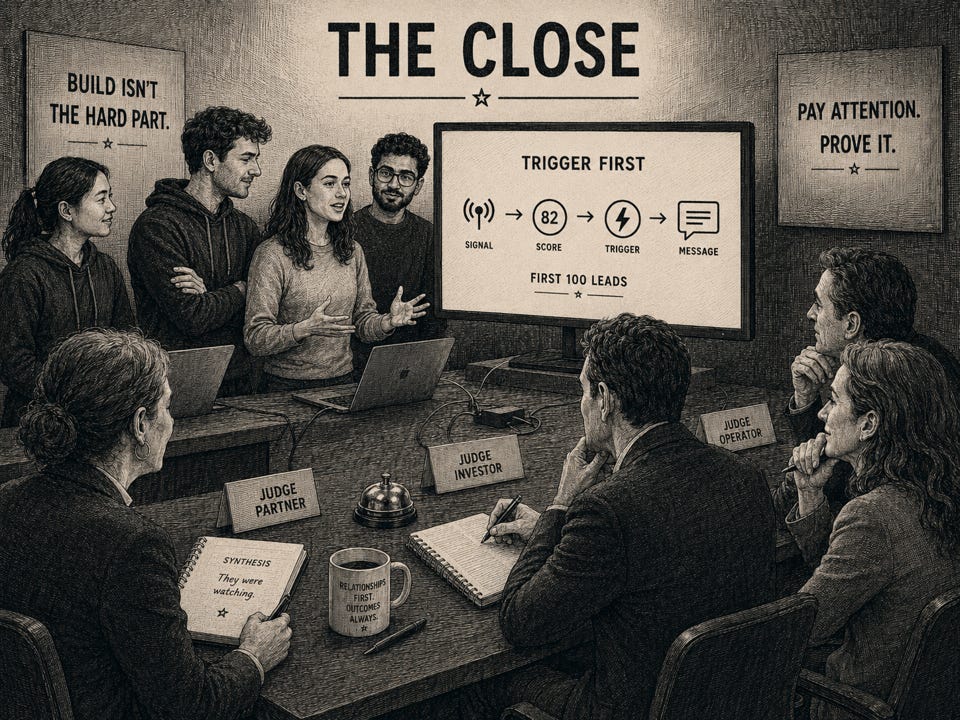
The hard part is the sentence before the demo. The one that proves you were paying attention to them.
Last month I wrote that the moat didn’t move, the buyer did.
Here is the follow on: The moat is gone. What is left is whether you can prove you were watching.
If you want to see what that looks like built out, I put the whole motion on one page. One hundred leads, sourced from live triggers instead of static lists, scored for relevance, and delivered with the trigger attached to every name so your first sentence writes itself.
Have a look when you have ten minutes: The First 100 Leads
No pitch attached. If the motion is useful and you build it yourself, that is a good outcome too.
Next in this series: the same five weeks, read through a CRO’s forecast. Then through a VP of sales’ Monday morning.
Sources
Cybersecurity Insiders and Saviynt, 2026 CISO AI Risk Report, January 2026, n=235 security leaders.