


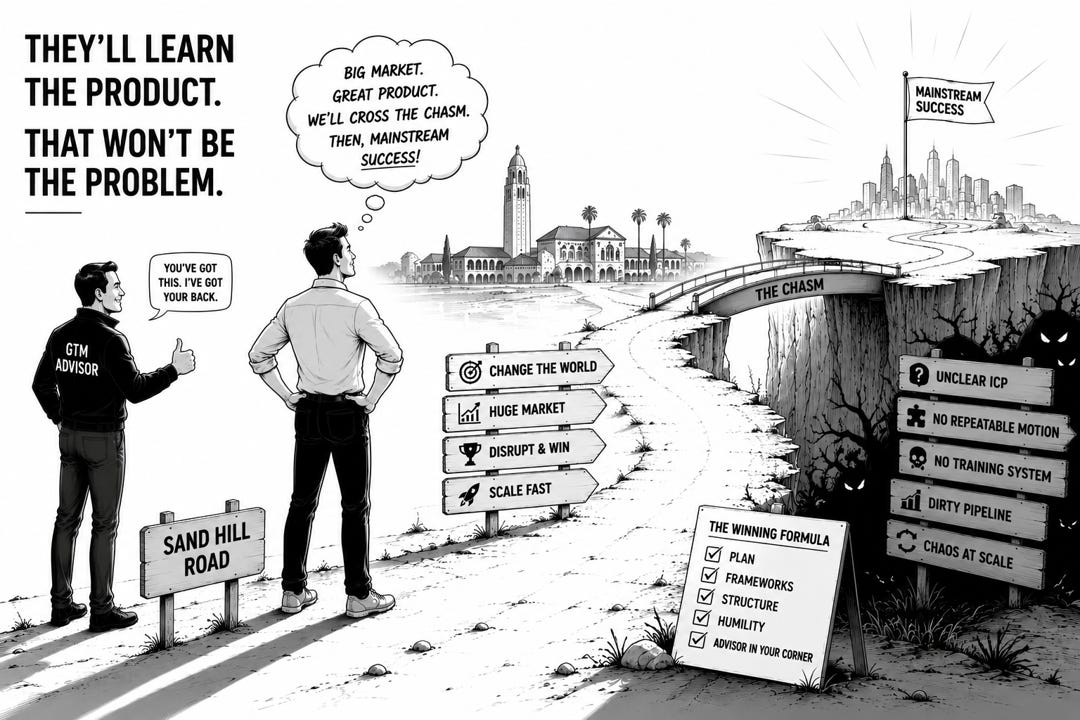
“Companies are great at educating on products. They suck at sales training. They really do. Most companies really do.”
That’s not a hot take from a Twitter thread.
That’s forty years of enterprise sales, delivered plainly, by someone who has lived every version of this problem.
I heard it this week. And it’s the most important thing a founder planning their first sales hire needs to hear right now.
Because you are about to make the same mistake.
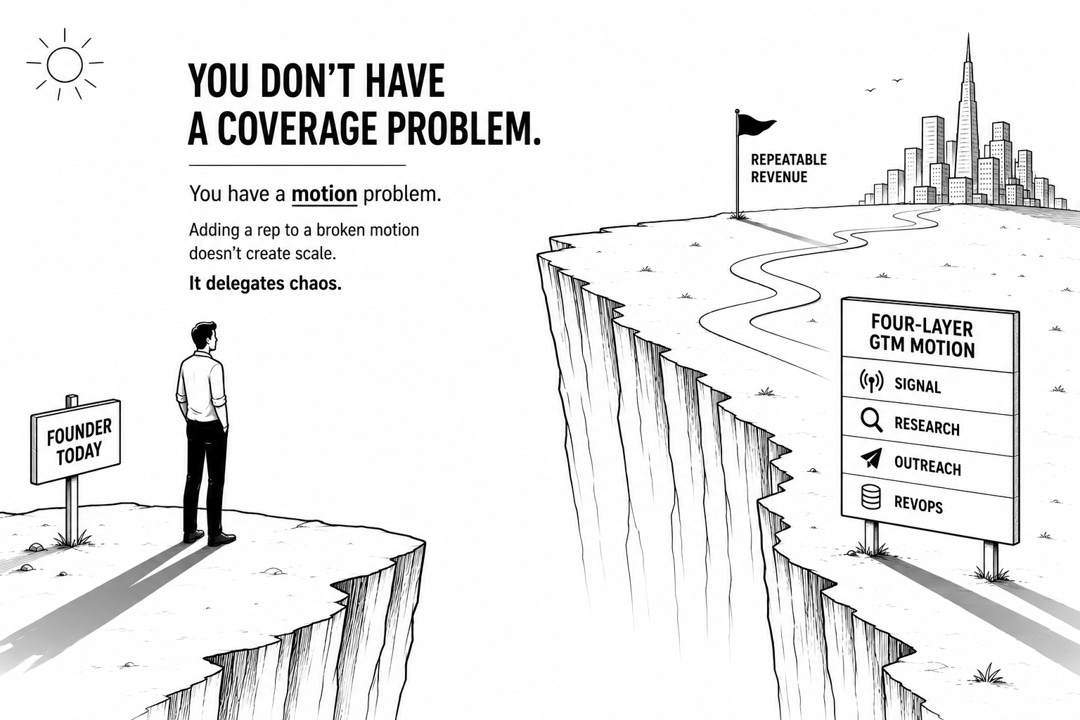
You Don’t Have a Coverage Problem
You think you need a person to make the calls you can’t make.
That’s not wrong. But it’s the wrong diagnosis.
What you actually have is a motion problem.
The ICP is in your head. The deal stages shift when the week changes. The follow-up “system” is your inbox. The training plan is a product demo, a handshake, and a hope.
Adding a rep to that is not scale.
It’s delegation of chaos.
Salesforce's 2024 State of Sales report found that reps spend 70% of their time not selling. That number doesn't improve when there's no system for them to inherit. It gets worse.
What Forty Years in the Field Looks Like
The sales veteran I talked to this week has seen this pattern play out at the enterprise level. Repeatedly, across decades.
His company had two kinds of salespeople: the ones in their 50s and 60s who had been around forever, and the ones in their 20s who were sharp but green. Nothing in the middle.
The experienced reps carried institutional knowledge. None of it was written down. When they left, it left with them.
The younger reps knew the product cold. Nobody taught them how to sell it.
Marketing owned the training. Some managers were strong. Some weren’t. After enough turnover, he said, you had the blind leading the blind.
That’s not a hiring problem. That’s a system that was never built.
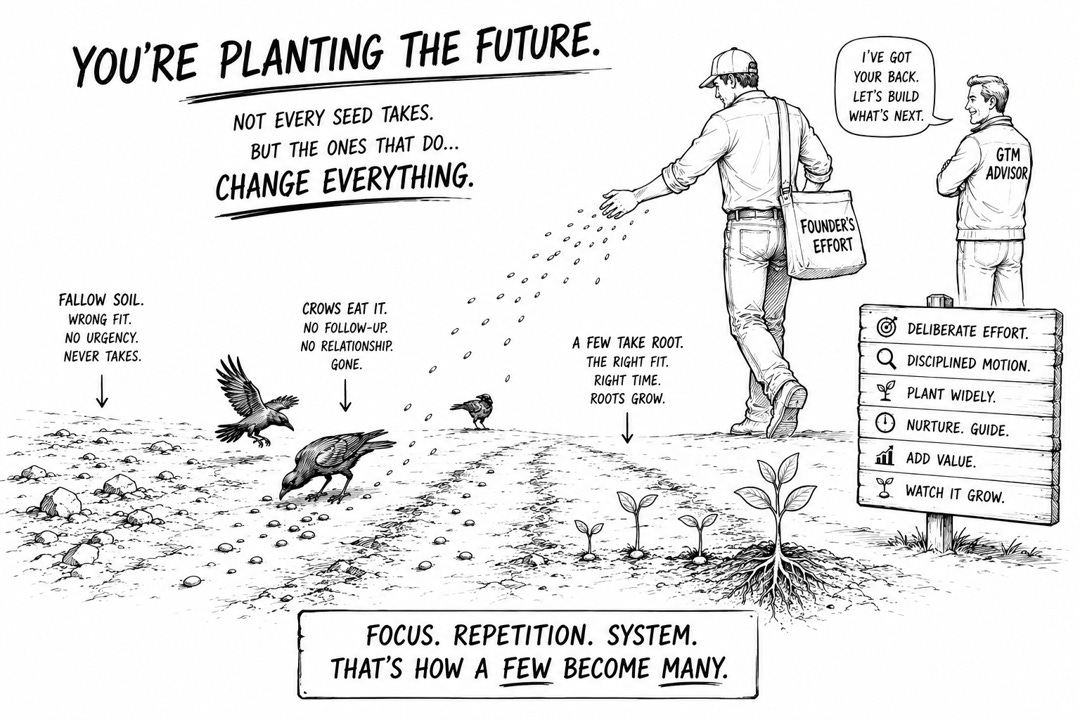
You’re not at the enterprise stage yet. But the seed of that failure is being planted right now, at your current stage, in the decision you’re about to make.
The Four-Layer Motion Your Hire Needs to Inherit
There’s a four-part GTM motion every sales organization runs, whether they know it or not.
Signal. Research. Outreach. RevOps.
Most founders have fragments of one layer when they post the job.
Here’s what the hire needs on day one:
Signal. A documented ICP. Not in your head. Who buys, who stalls, what triggers urgency, what disqualifies fast. Written. Searchable. Not a Slack thread.
Research. Account context that doesn’t require the founder to brief the rep before every call. Personas, stakeholder maps, conversation history. A system that holds memory so the rep doesn’t have to.
Outreach. A repeatable prospecting motion already running. Personalized at scale. Not five manual messages a day that only work when you send them.
And here’s where something shifted this week.
I was in North Beach San Francisco Wednesday. Not a conference. A confluence. Our cohort at HeyGen calls it “Infinitely Me”.
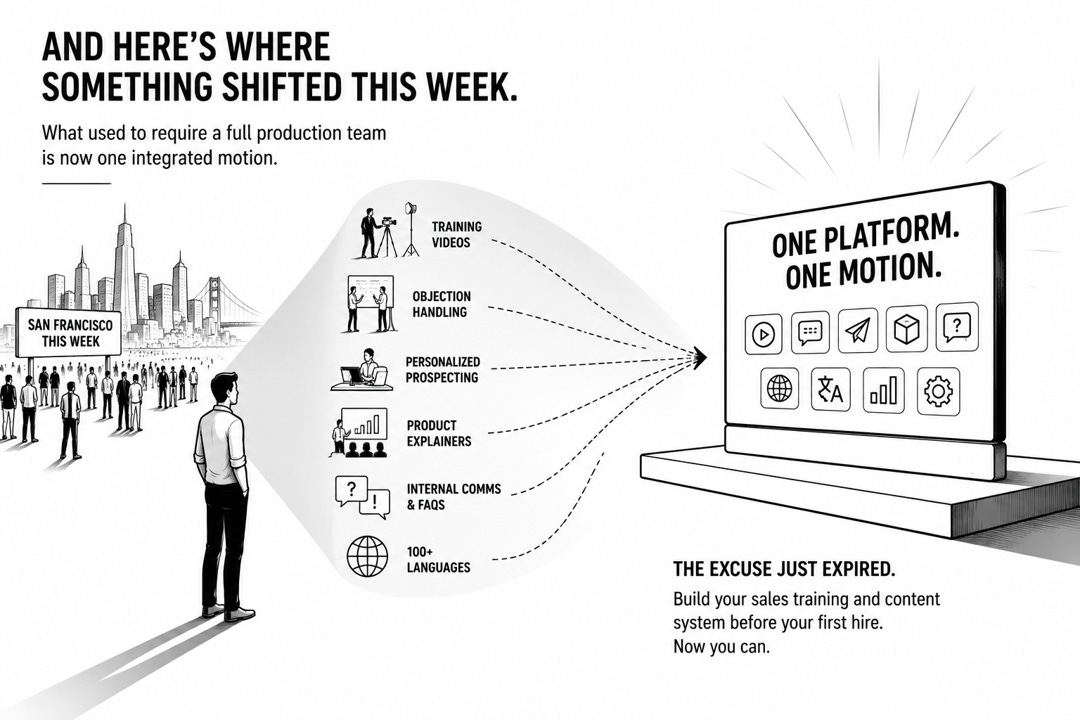
I watched a platform compress what used to require a full production team into a single motion. Training videos. Objection handling walkthroughs. Personalized prospecting clips. Product explainers. Internal comms. FAQs. 100+ languages.
One platform. One motion.
The excuse that you couldn’t afford to build a sales training and content system before the first hire just expired. I watched it die in real time.
RevOps. A pipeline your rep can trust. Deal stages that don’t move. A CRM with actual data in it. A forecast that isn’t your gut.
The rep doesn’t build this system. They run it.
If it doesn’t exist when they walk in, they spend their first 90 days constructing the runway while standing on it.
That’s your runway. Measured in dollars and months.
The Founders Who Win in 2026
They are not the ones who find the best first sales hire.
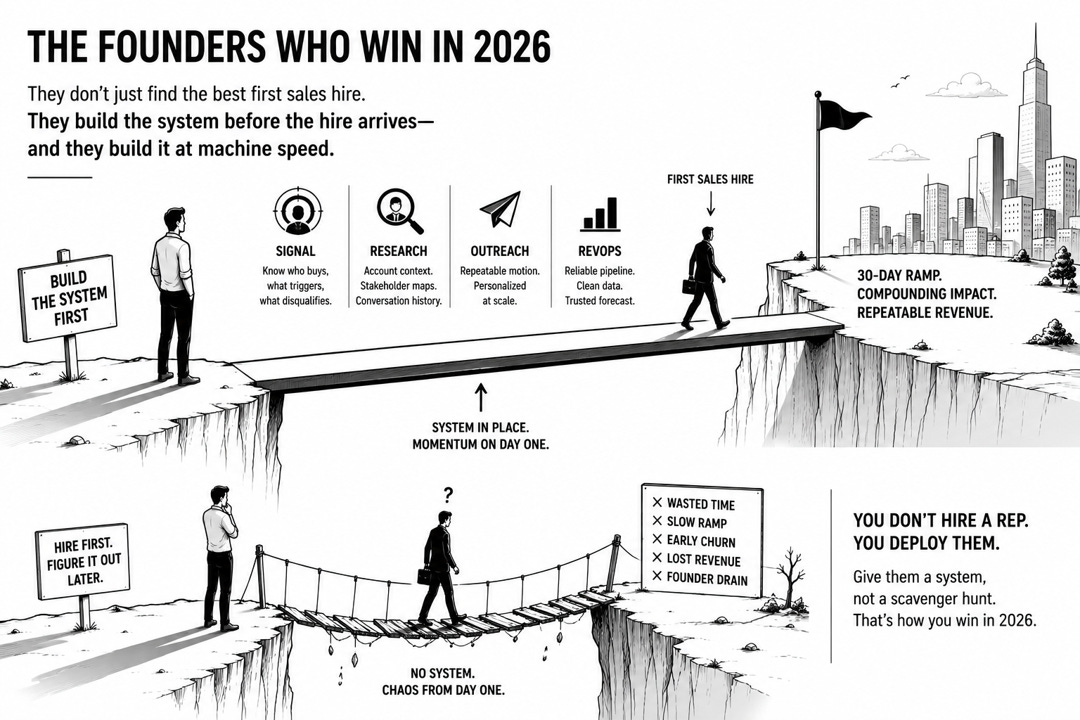
They are the ones who build the system before the hire arrives, and they are building it at machine speed.
Content motion. Signal layer. Outreach sequence. Operational foundation.
The rep they hire doesn’t inherit a blank whiteboard. They inherit momentum.
That is the difference between a 30-day ramp and a 90-day experiment.
Mark Roberge, who scaled HubSpot from zero to $100M as founding CRO, puts the undocumented ramp at four to six months. Most founders budget for three.
Before You Post the Job
I built a five-minute diagnostic for exactly this crossroads.
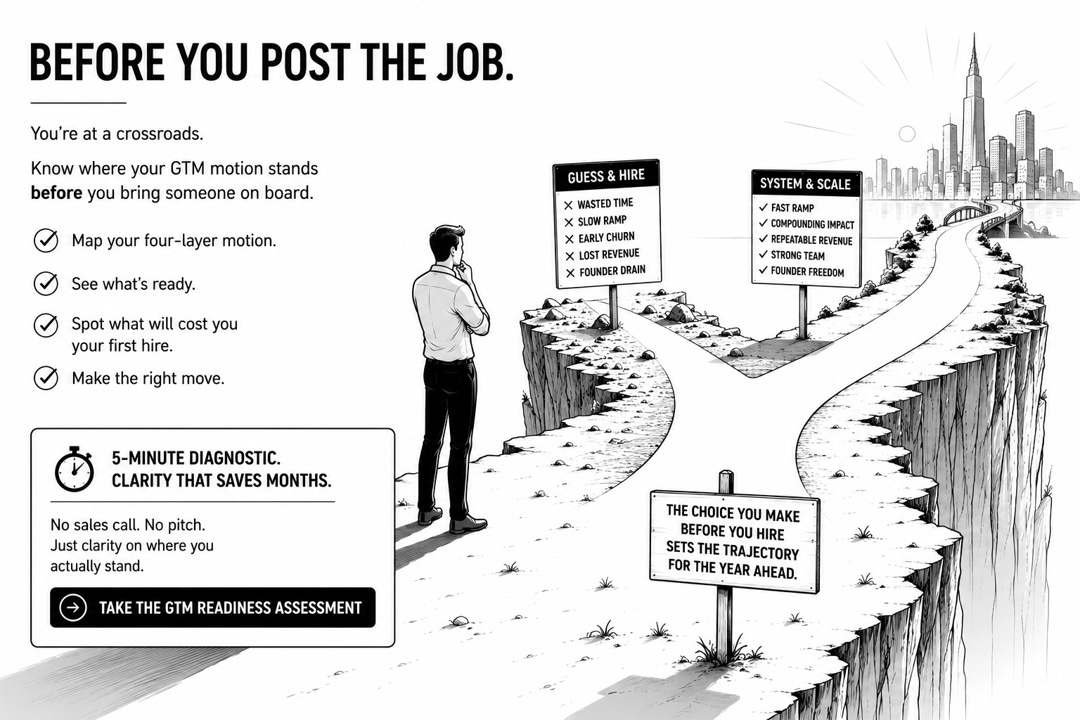
It maps which of the four layers are ready and which ones will cost you your first hire before they close a single deal.
No sales call. No pitch. Just clarity on where you actually stand.
Try it before you post the job.