


This week I was told which LLM to use three different times.

I got three different answers.
Monday it was one model 5.0. Wednesday it was another frontier company. By Friday, the Wednesday answer was “so last quarter.” Let’s go back to the original frontier model company’s next version 5.5.
None of that advice was wrong. It just expired fast.
That’s the real signal. In a market this fickle, betting your GTM motion on one tool is the mistake.
Here’s what I noticed this week, and what I’m doing about it.
Bring your own harness
Every week there’s a new leaderboard. A new benchmark. A new “this changes everything.”
If you rebuild your workflows every time the leaderboard flips, you will never ship anything.

My takeaway: own the harness. Rent the model.
A harness is the operating layer around a model: the context it receives, the tools it can use, the memory it draws on, and the rules that guide the work.
I keep my core context in one place: my notes, brand voice, ICP definitions, and runbooks. Claude reads from it directly. I export the material for Gemini, OpenClaw, Hermes, Llama, GPT, and others.
The models change. My source of truth stays portable.
When the advice flips next Tuesday, I swap an engine. I don’t rebuild the car.
For a CRO, this is a data integrity question. For a founder, it’s capital efficiency. You paid to build that context once. Don’t pay again every time a vendor ships a press release.
Advice is fickle. Your context shouldn’t be.
LinkedIn split in two. That imposes a new discipline.
LinkedIn now gives me two feeds: For You and Network.
At first that felt like a small UI change. It isn’t. It’s two different jobs.
For You is for discovery. I use it to find people and ideas I don’t know yet. New voices. New operators. New angles on problems my clients have.
Network is for action. I use it to act on relationships I already chose. Existing connections. People I’ve met, worked with, or deliberately decided to follow.
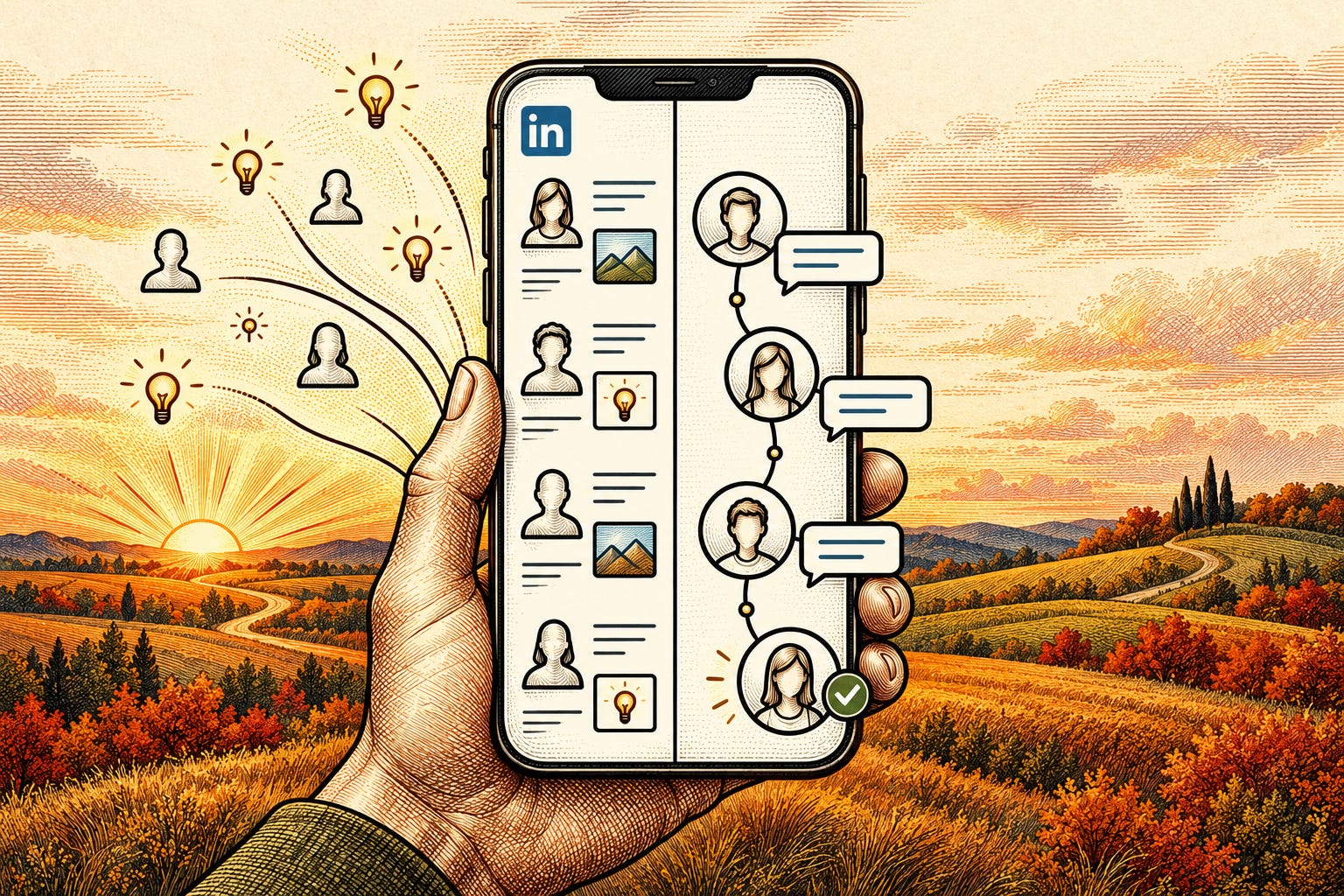
Mix those up and you get noise. You scroll For You and call it relationship-building. You scroll Network and call it research. Neither happens.
This maps cleanly to the 4-layer motion. For You feeds the Signal layer. Network feeds Outreach. Separate the inputs and each layer gets cleaner.
The discipline: decide which job you’re doing before you open the app.
SF Tech Week: win it before you land
SF Tech Week is almost here.
For a week, the whole city comes alive. Technologists. Venture capital. Private equity. Startup founders. Engineers and builders. All of them steeped in the AI motion, spread across dozens of events hosted by dozens of companies.
That density is the opportunity. It’s also the trap. With that many rooms, you can stay busy all week and come home with nothing but a lanyard collection.

The ROI of a conference is decided before you get there. Here’s my pre-conference checklist. It works for any event, but it matters most at one this big.
Pick three outcomes. Not “network.” Three specific results. Two meetings with a named ICP. One partner conversation. One piece of content.
Choose your rooms, not just your events. Tech Week is a buffet. Pick the five or six sessions where your buyers and partners will actually be. Skip the rest without guilt.
Build the target list from the agenda. Hosts, speakers, and sponsors are published. That’s a free Signal layer. Research them now, not in the hallway.
Use both feeds. Search For You for people posting about Tech Week. Check Network for existing connections who’ll be in town. Warm first, cold second.
Pre-book the meetings. A message sent a week out beats a handshake in a crowded room.
Set up capture before you leave. I record sessions and conversations to transcripts so I can process them later instead of scribbling. Decide where the notes land before day one.
Schedule the follow-up now. Put a 48-hour follow-up block on your calendar before the week starts. The follow-up is where the pipeline actually gets built.
A conference isn’t an event. It’s a campaign with a venue.
Harvest season changes what buyers care about
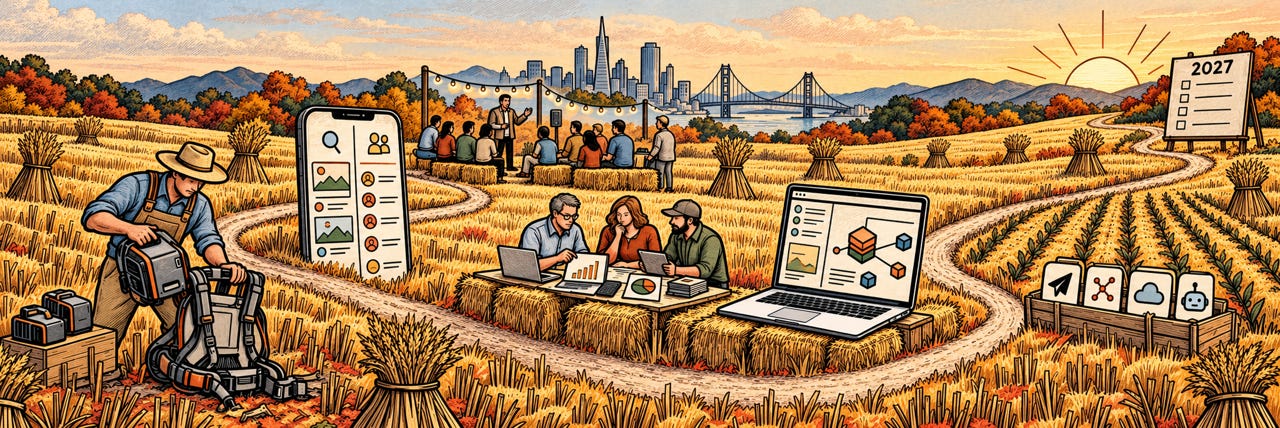
It’s fall. Harvest season.
On the farm, this is when you stop planting and start bringing it in. Business works the same way.
The mindset of the people you sell to shifts right now. If your messaging doesn’t shift with it, you’ll sound like you’re talking to someone who left the room in June.
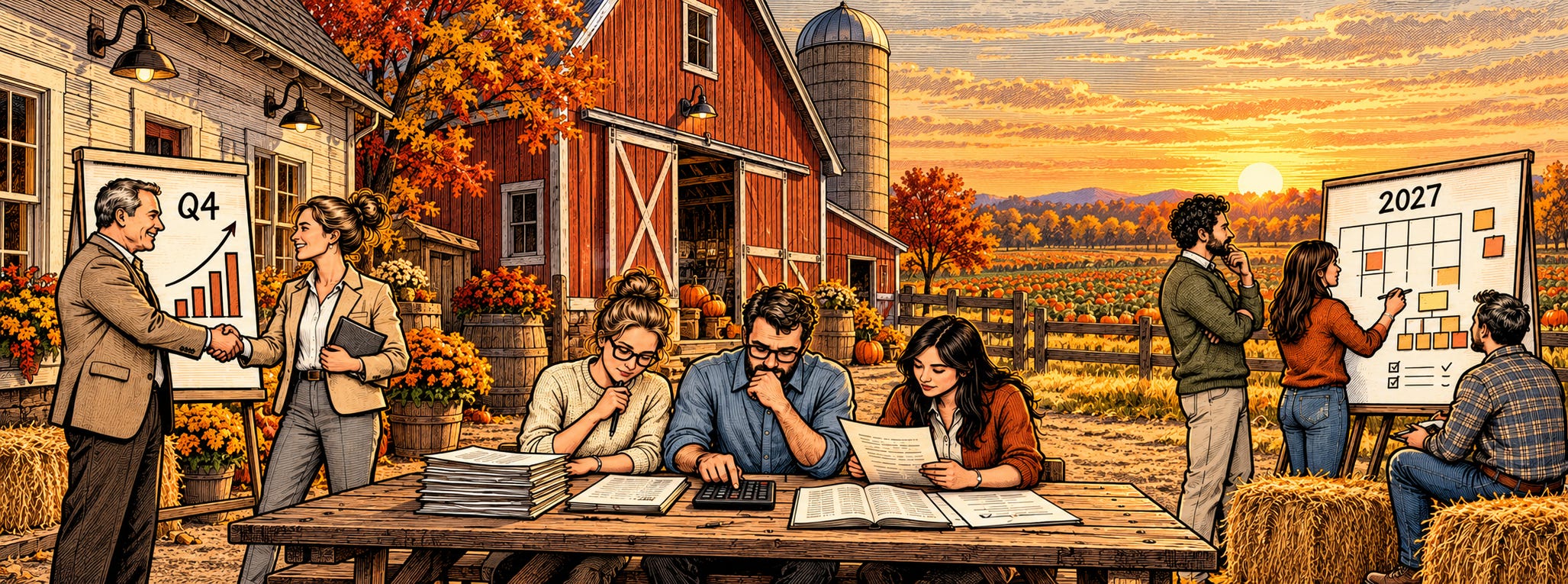
Here’s what I see changing:
CROs and VPs of Sales are closing, not exploring. Q4 is about landing the number. Anything that doesn’t help close this quarter gets pushed to January.
Finance is watching every dollar. Your buyer’s CFO and FP&A partners are reconciling the year. Remaining budget is either getting spent with purpose or getting clawed back.
Founders are planning 2027. The smart ones use Q4 to decide what next year’s motion looks like. Headcount plans. Tool consolidation. What to stop doing.
Everyone is tired. It’s been a long year. Short, specific, and useful beats long and clever.
So adjust. Talk about what closes now or what sets up next year. Skip the “let’s explore” pitch. Nobody is planting seeds in October.
If you’re one of those founders mapping 2027 right now, start with an honest read on where your motion stands today. I’ll point you to a quick way to get one at the end of this piece.
Launching gtmsos.ai
The new site is live at gtmsos.com. I bought the ai domain after the rebuild wrapped, and gtmsos.ai now 301-redirects to it until the domain migration phase.
But the domain isn’t the real launch. The architecture is.
GTMSOS now runs as a set of connected pieces. WordPress is the primary site CMS. Gamma runs a landing page factory on a ‘go’ subdomain. ScoreApp powers the GTM Assessment. Calendly handles booking. Substack carries the writing.
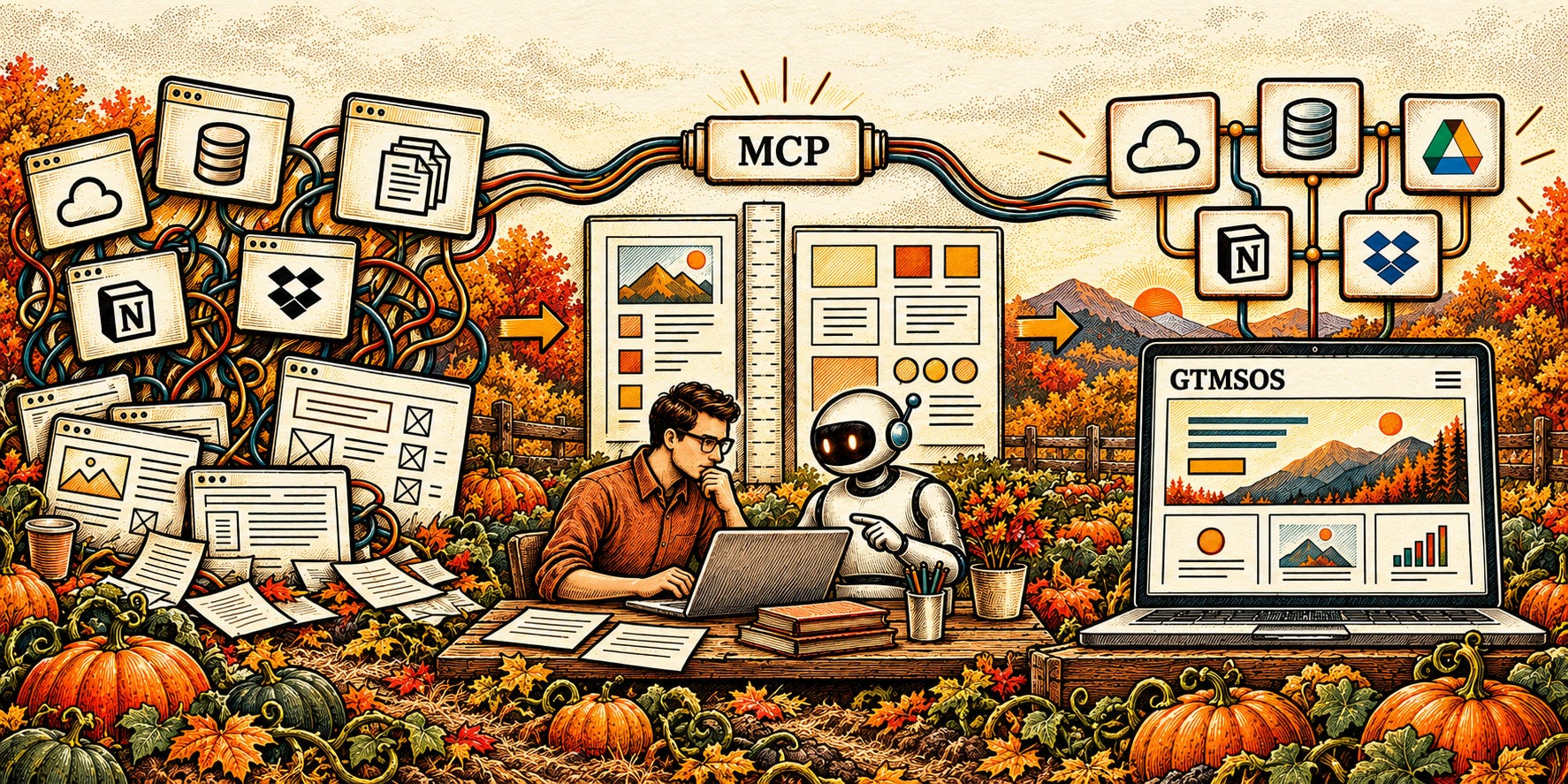
Five platforms. One brand.
The hardest part wasn’t any single platform. It was UX coherence. Making five tools, each with its own defaults, look and feel like one company. I wrote a design canon first: exact colors, three fonts, spacing on an 8px grid, banned colors, a rule for every corner radius, yada yada. Then every platform got measured against it.
The second big move was letting my AI chief of staff work inside WordPress directly. That runs through Novamira’s MCP server, which gives an agent real access to the site instead of me copying and pasting. The quest for this capability pulled me through lots of resistance.
That’s where the zigs and zags started.
Zig: the first login path failed. Repeated login attempts tripped a rate limit on the command-line route. The MCP connection worked immediately. I dropped the CLI and never looked back.
Zag: the old site had baggage. 41 pages. Only 4 linked from anywhere. The other 37 were leftovers from a previous business identity, still public. The browser tab still read “Productivity Blog.” The share image was a photo of me from 2017. Your website accumulates debt the same way your CRM does. Quietly. Until someone looks.
Zig: none of the fixes were live. After a long session of colors, fonts, spacing, and headings, everything looked great. On staging. The public site still showed the old version. Staging is where you practice. Production is where you get paid.
Zag: the platform fought back. GoDaddy’s managed WordPress was the problem. Cloudflare kept blocking my agent’s connection to the site. So I moved hosts mid-project, out of managed WordPress and into cPanel hosting. The Cloudflare blockage is no longer an issue. The price was new tools, a new staging copy, and a process I had to relearn from scratch.
Zig: direction is everything. Pushing staging to production is one button. Push it the wrong way and you wipe out your own work with the old site. That rule is now written in red in my runbook.
Zag: the post-launch surprises. After the first cutover, two things broke. Search engines were blocked, because a staging setting traveled with the data. And the site’s address came back as http instead of https. Fixing that took 733 replacements across the database. Neither was a disaster. Both would have been if nobody checked.
The fix for all of it: write the runbook while it’s fresh. I documented the process the same day, including the steps I wasn’t sure about. The next cutover will take a fraction of the time.
The agent did most of the heavy lifting. The judgment calls stayed mine. Which pages to retire. What the headline says. When to push the button.
That’s orchestration. The agent executes. The composer decides.
Clearing the field
Harvest isn’t only about bringing the crop in.
It’s also when you clear the field. You pull the old stalks, fix the fences, and decide what gets planted next season. Skip that step and next year’s crop grows up through last year’s debris.
That’s what my migrations are for.
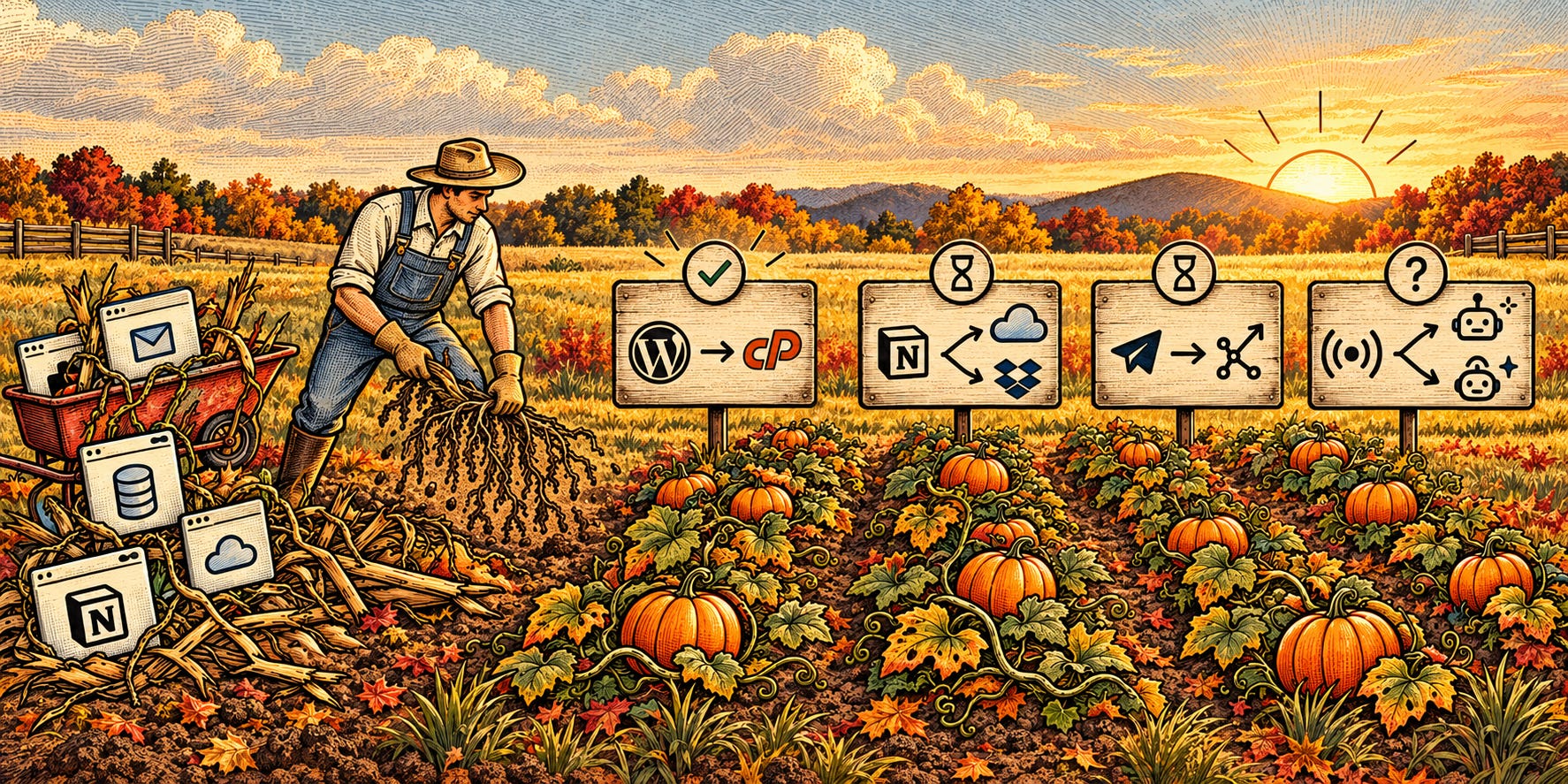
The projects absorbing most of my time lately aren’t new builds. They’re migrations. One is done. The rest are on deck.
Done: managed WordPress to cPanel hosting at GoDaddy. More control, a real staging workflow, and direct access for my agents.
On deck: Neat to OneDrive or Dropbox for records. One less specialized subscription. Records live where everything else already lives.
On deck: Instantly to HeyReach. Rethinking the Outreach layer around where my buyers actually respond.
Evaluating: what replaces Trigify. HubSpot acquired Trigify. When a signal tool gets absorbed into a platform, you have to decide whether to follow it or rebuild the layer. Grok Bot from xAI has been a siren song lately, and so has MoltSets. I haven’t committed to either. But I’m curious, and my Signal layer is up for review.
None of these look hard on a slide. All of them are.
Each migration means new integrations. New data mappings. New processes. New failure points to test. My chief of staff agent has been busy mapping fields, rewiring automations, and catching what breaks.
So why do it?
Two reasons.
First, room. Every tool I retire makes space for something newer. New technology, new processes, and a new stack that gives me capabilities the old one couldn’t. You can’t plant the new crop in a full field.
Second, cost. Subscriptions creep. A tool you signed up for in 2024 renews quietly every year whether you use it or not. Fall is when budgets get set, so fall is when I audit every line. Cut what doesn’t earn its keep before it renews into next year.
And the tools are replaceable because the system isn’t tied to any one of them. That’s the same lesson as field note one. Own the harness. Rent the tools. When a vendor gets acquired, raises prices, or falls behind, you move in weeks instead of quarters.
This is how you scale revenue without headcount. Not by picking the perfect stack. By building a system that survives when the stack changes.
The thread through all six
Fickle model advice. A split feed. SF Tech Week. A season. A site. A field to clear.
Different topics. Same lesson.
The tools will keep changing. The system is what compounds.
Before you plan 2027
Harvest season is when you take stock. Most GTM leaders do it with a gut feel and a spreadsheet.
I built a five-minute diagnostic instead.
The GTM Readiness Assessment scores your motion across the four layers: Signal, Research, Outreach, and RevOps. It shows which layers are ready to carry next year’s number and which ones need clearing first.
No sales call. No pitch. Just a clear read on where you stand.
Take it before you lock next year’s plan.
I write about AI Orchestration for GTM leaders every week. If this one landed, forward it to a founder who’s heading into SF Tech Week or planning 2027 right now. Thank you.