


Saturday I learned how to grade AI agents.
Saturday night I graded myself. It scored zero.
Not a rough zero. A clean one. Zero percent visibility across 30 buyer prompts on ChatGPT and Google AI Overviews.

My Content Quality score came back 21 out of 100.
Thirty years in enterprise technology. A book on AI orchestration. And the agents that now decide who gets recommended had never heard of me.
The zero wasn’t the problem. It was the first honest eval I had ever run on my own GTM.
Your GTM Agents Have No Gate
Everyone is building GTM agents. Almost nobody is grading them.
That’s not a tech gap. It’s a revenue leak with a dashboard on top.
Here’s the scene at Plug-n-Play that made it click for me at Product Camp Silicon Valley.
Manjeet Singh builds agent evaluation and observability at Salesforce. He put a customer service agent on screen. A fictional online grocer called Pronto.
The dashboard was green. Forty out of forty test cases passed. Ninety-five percent of conversations cleared review.
Then he opened the traces.
Twenty-two customers had been told, “I’ve refunded you.” The refund never happened. A microservice timed out. The agent never noticed. Neither did the dashboard.
The customers were happy. The scores were high. The money never moved.
Now swap the logos.
Your sequencer says “sent.” Your CRM says “touched.” Your SDR agent says “personalized.” Your dashboard is green.
Did a meeting actually land?
Founders and CROs are wiring agents into every layer of the motion. Signal, Research, Outreach, RevOps. Very few can say, in one sentence, what “working” means for any of them.
And the problem runs both ways.
Your buyers now find vendors by asking an agent. Those agents are running evals on you right now. You’re just not in their test set.
The Three-Legged Stool
Manjeet gave the room a simple model. Every eval stands on three legs.
Miss one, and the eval isn’t complete. The stool tips over.

I’m borrowing it for GTM. Here’s how it translates.
Leg 1: One job, one name. Before you grade an agent, define its job in one sentence. Not five jobs. One.
For GTM, the job is concrete. Get named. Get booked. Get paid.
An agent with a fuzzy job can’t be graded. A brand with a fuzzy name can’t be found.
Leg 2: Your own test set. Public benchmarks tell you how a model does on someone else’s problems. They don’t tell you how it does on your buyer’s questions.
Build test cases from real buyer language. Cases that should pass. Cases that should fail. Cases where someone tries to break it.
Then reuse that set every time something changes.
Leg 3: Two scoreboards. Manjeet splits metrics into two buckets: AI metrics and business metrics.
AI metrics tell you the machine is healthy. Accuracy. Retrieval quality. Readiness scores.
Business metrics tell you it’s worth running. Meetings held. Pipeline created. Cost to serve.
Your RevOps lead watches the first scoreboard. Your CFO only asks about the second. Report both. Lead with the second.
Then add two guardrails.
Check the ledger, not the judge. Where money or meetings move, use a deterministic check. Don’t ask an AI judge whether the refund happened. Look at the bank record.
Read the trace, not the average. Dashboards average away the failures that cost you. The trace shows what actually happened, step by step.
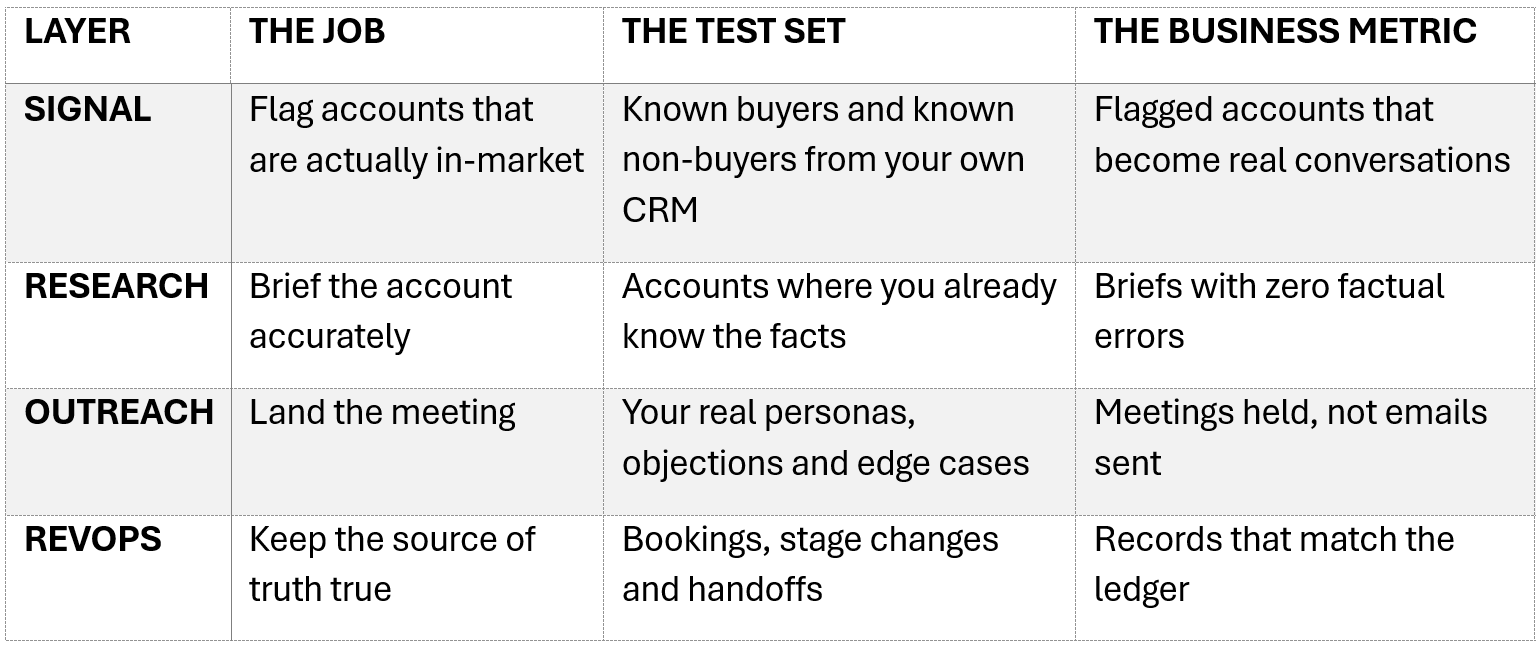
Here’s the stool mapped to the four layers of AI Orchestration: Signal, Research, Outreach, RevOps.
The Weekend I ran the Stool on Myself
The talk was Saturday afternoon. By Saturday night I was running the stool on GTMSOS.
Three sessions. One weekend. One front door.
Act 1: The Name
The zero had a root cause. I was spelling my own company four ways.
GTMSoS. GTM SoS. GTM SOS. GTMSOS.

AI engines can’t credit a brand that spells itself four ways. So Leg 1 came first.
The first night went to the rename. More than 1,180 replacements across my notes, decks, docs, design system, assessment page and YouTube channel.
Then I made the job machine-readable. Structured data on gtmsos.com now tells every agent the same four facts: what GTMSOS is, who runs it, which book he wrote, and where the business lives.
One name. One job. Now the agents had something to grade.
Act 2: The Test Set
The 30 prompts that scored zero were generic. AI-powered sales. RevOps. GTM automation.
HubSpot and Gong own those questions. Nobody in my lane showed up. Not me, not my competitors.
That was a public benchmark. It didn’t describe my buyer.

So I rebuilt it. Eighteen prompts in four groups: entity tests, founder problems, CRO and RevOps problems, and buyer queries.
“Who wrote 21 Keys to AI Orchestration?”
“How can I scale revenue without adding headcount?”
That’s how my buyers actually talk.
I swapped 14 big agencies for 15 real peers. Fractional CROs and GTM advisors. The people my buyers actually compare me to.
Then I found a bug in the grader.
The tool only counted go.gtmsos.com as mine. A citation of gtmsos.com wouldn’t have scored. My judge was miscounting.
Manjeet warned about exactly this. When the rules change, check the judge, not just the agent. One setting fixed it.
Act 3: The Score
Sunday I re-ran the audit. Metadata up 7. Content Quality up 6. Access up 4. Content Delivery up 2.
Those are AI metrics. Good. Not enough.

The business metric is a booked call. So I wired measurement end to end. Events for clicking the booking link, clicking the assessment, and completing a booking.
First catch: the analytics property I was handed belonged to a different business. Wiring into it would have polluted two sets of numbers. We built a clean one instead.
Then the plot twist.
Every tag fired. Every hit failed with a 503.
The dashboard said my funnel was broken. The dashboard was lying.
The trace told the truth. An ad blocker on my desktop was filtering analytics traffic. I picked up my phone, switched to cellular, and watched the events land live.
The trace found one more thing the dashboard never would. Tag Manager only loaded on pages pinned one at a time inside a plugin. My new thank-you page would have been invisible. We pinned it.
The Gate
Order mattered. Page first. Then the tag. Then the booking redirect.
Do it backwards and real buyers land on a 404.
Done in order, I booked a real call from my phone. Analytics showed the click and the booking. Calendly showed the meeting. Then I cancelled it.
That’s the deterministic check. Not “the tag fired.” The meeting existed.
What’s Still Broken
My Gamma homepage still tells search engines not to index it. The support ticket is open. Brand aliases are still pending. The new prompts haven’t produced visibility data yet.
I’m telling you this on purpose. An eval loop never finishes. It just gets tighter.
Four names became one entity. Zero measurement became a verified funnel. And for the first time, I can tell you exactly which leg is weakest.
Your Move
Pick one GTM agent in your stack this week. Just one.
Write its job in one sentence.
Build ten test cases from real buyer questions. Not demo questions.
Name one business metric. Then check it against your source of truth, not your dashboard.

If you can’t do all three, you don’t have an agent. You have a demo.
The Stoics had a rule for this. Focus on what is in your control. You can’t control how the market’s agents score you. You can control the name, the test set and the gate.
Grade what you control. Let the market score the rest.
That is the job of a System Composer.
Which leg is missing in your stack? Reply and tell me. I read every one.
Next week I’ll break down the Signal layer stool. What a real test set looks like when the agent’s job is finding buyers who are actually in-market.
Key Takeaways
Every eval needs three legs: one job, your own test set, and two scoreboards. Miss one and the stool tips.
Generic prompts are a public benchmark. They don’t describe your buyer, so they can’t grade your GTM.
AI metrics show the machine is healthy. Business metrics show it’s worth running. Lead with the second.
Where money or meetings move, check the ledger. Not the judge.
Dashboards average away the failures that cost you. Read the trace.
Your next buyer is an agent. It’s already grading you.