


My AI stack blew through a month’s token budget in three days.
Not because I suddenly started using it more.
Because something in the system was configured differently than I thought.
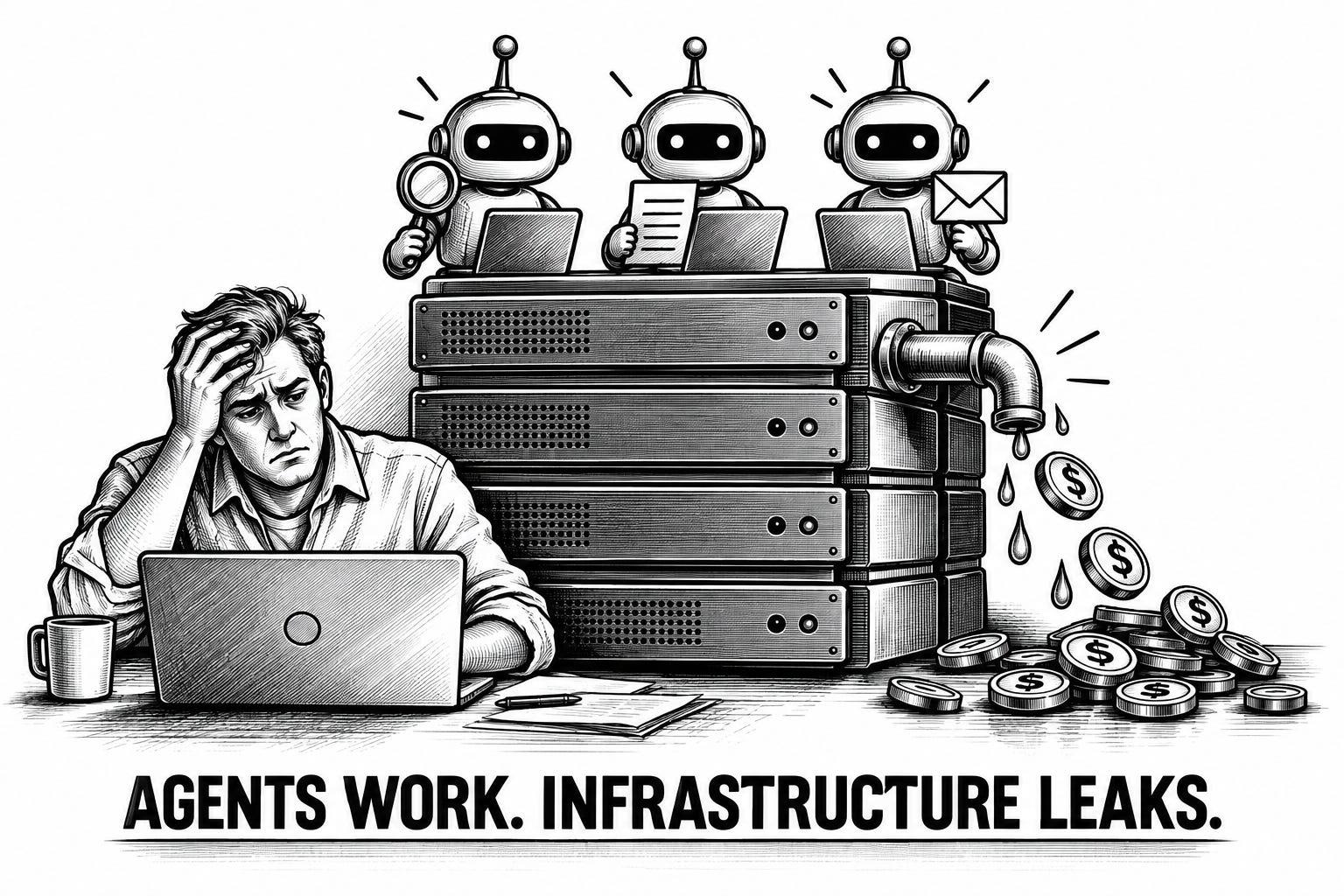
That was the moment I stopped treating my agentic GTM stack like a finished product.
It isn’t one.
It’s a living operating system. And like the revenue engine it’s supposed to support, it needs maintenance, monitoring, governance, and someone accountable for keeping it healthy.
The audit nobody budgets for
Every founder, CRO, and VP of Sales I talk to seems interested in AI orchestration.
Far fewer are interested in maintaining it.
We like the story that agents reduce headcount, automate workflows, and give small teams more leverage.
We skip the other side of the equation.
Agents themselves need an owner.
They need health checks.
They need permissions.
They need cost controls.
They need recovery plans.
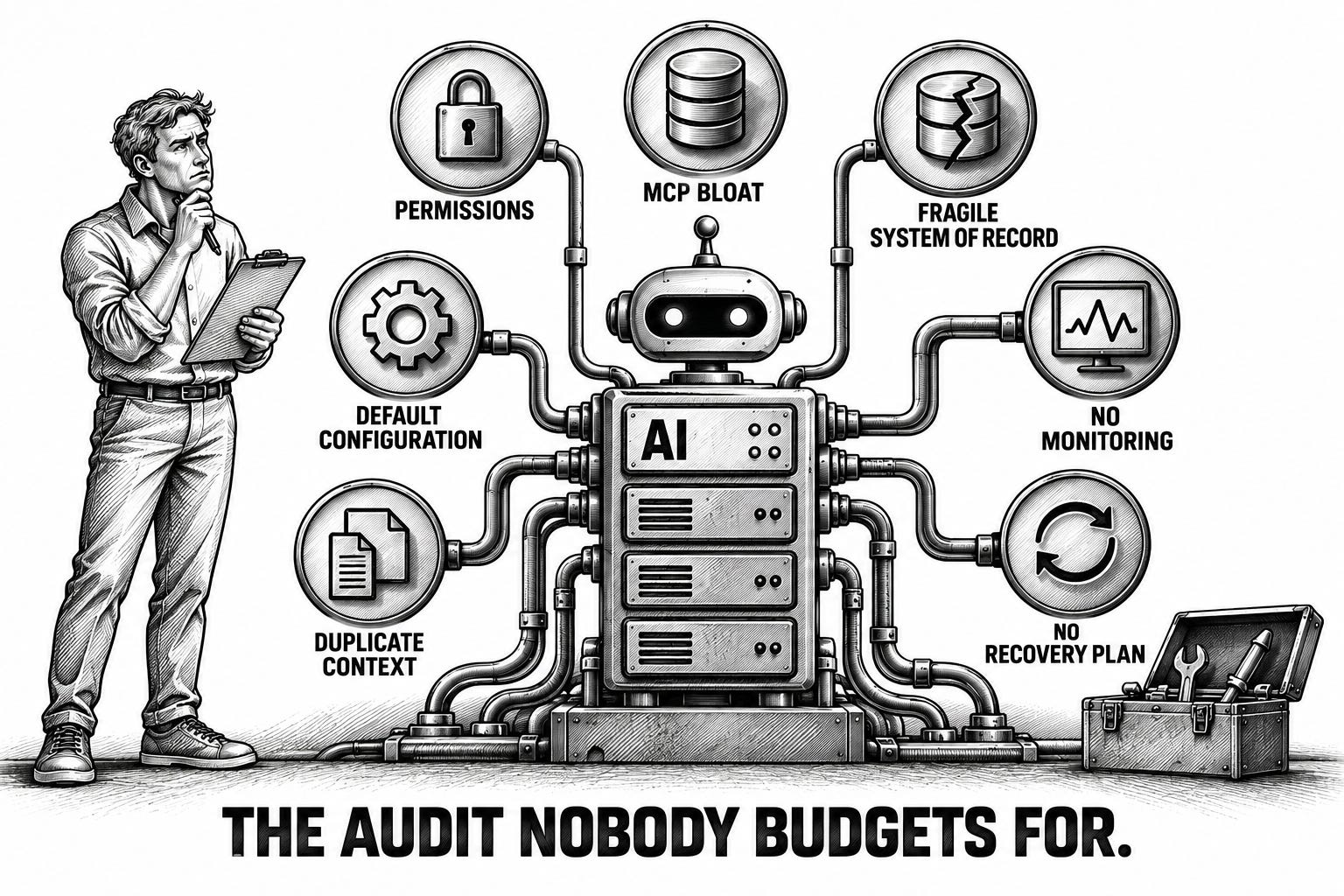
So I audited my own stack.
Here’s what I found.
My permissions were too restrictive.
Early caution had turned into permanent policy. Several workflows couldn’t complete without me clicking through approval prompts.
I wasn’t governing access based on risk.
I was governing it based on fear.
I had MCP bloat.
Connectors had accumulated over time. Many had been installed for one experiment and never touched again.
Nothing was catastrophically wrong.
But every unused dependency increased complexity.
My system of record had become fragile.
One registry file had quietly grown with every event the system logged.
It was still working.
But one bad write could have turned a boring maintenance problem into a recovery project.
I had no system-health monitoring.
No dashboard.
No alerts.
No obvious signal that a workflow had failed.
I usually discovered the problem when I went looking for an output and it wasn’t there.
My model configuration wasn’t explicit.
A default setting was driving behavior and cost that I had never consciously chosen.
The important lesson wasn’t which model was selected.
It was that a critical operating assumption lived as a default instead of a decision.
Failed agent runs had no recovery path.
If a sequence crashed halfway through, I couldn’t resume from the point of failure.
The recovery plan was essentially:
Start over.
Hope it works.
My context layer was duplicating itself.
The same information existed in multiple systems in slightly different forms.
Nothing forced those versions to stay synchronized.
So they slowly drifted apart.
None of this showed up as one dramatic failure.
It showed up as friction.
A slow leak, not a burst pipe.
The maturity ladder underneath the mess
I’ve been comparing notes with other AI-native builders, and the same pattern keeps appearing.
One founder I follow, Amos at Swan, described an evolution that will sound familiar to anyone building an agentic company.
You start with local files.
Then come scripts.
Then specialized agents.
Then shared context.
Then multiple people and multiple agents begin depending on that context.
And suddenly what worked beautifully for one person becomes infrastructure.
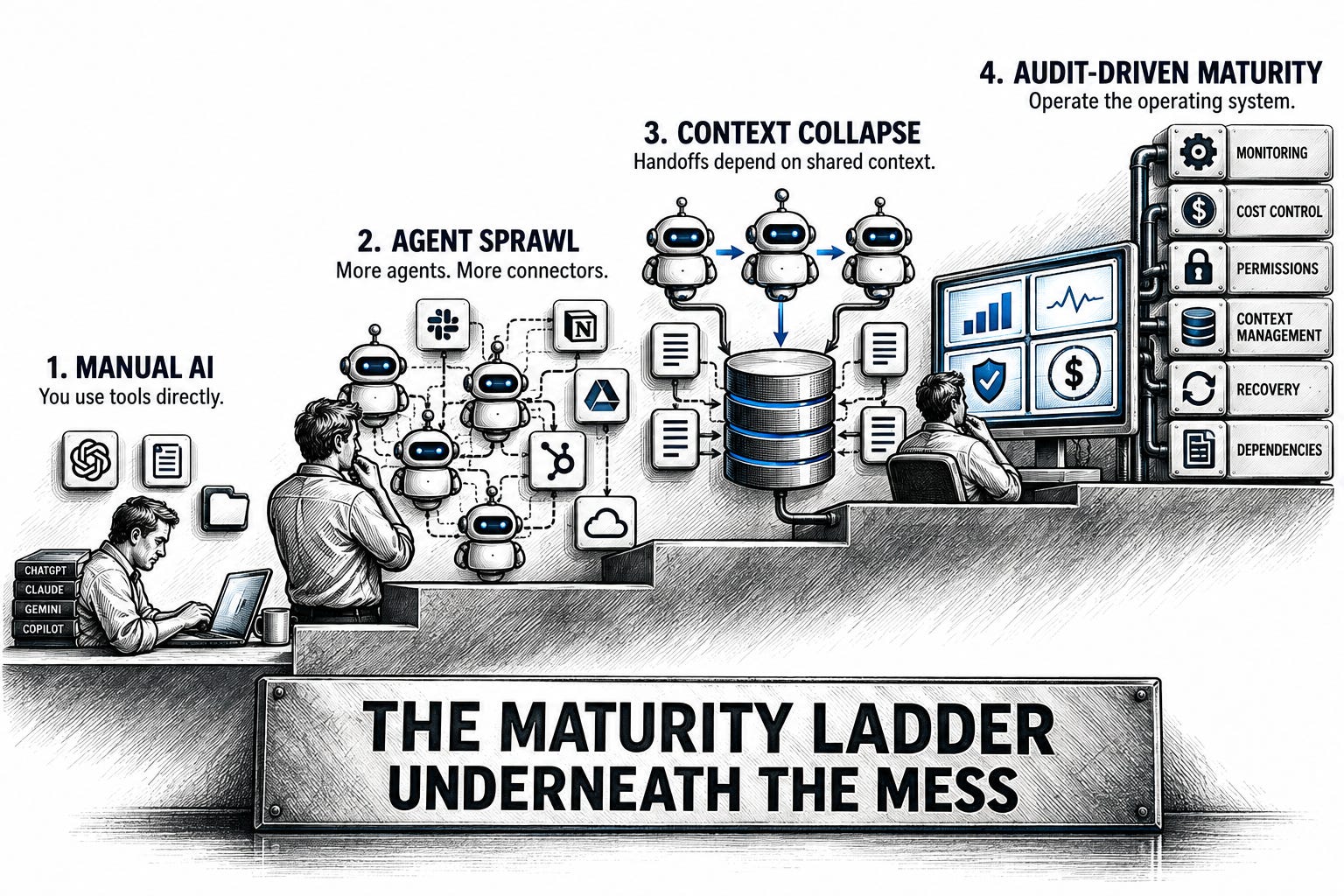
Strip away the specific tools and you get a maturity ladder that almost every GTM team running agents will eventually climb.
Stage 1: Manual AI
You use models and tools directly.
There isn’t much infrastructure debt because there isn’t much infrastructure.
The human is still the orchestration layer.
Stage 2: Agent sprawl
You automate more workflows.
Agents multiply.
Connectors accumulate.
Similar logic gets recreated in different places.
Permissions become inconsistent.
The system is becoming useful.
It’s also becoming harder to see.
Stage 3: Context collapse
This is where things get interesting.
Signal hands something to Research.
Research hands something to Outreach.
Outreach hands something to RevOps.
Those handoffs depend on shared context.
But nobody has been maintaining the context layer.
Registry files age.
Memories duplicate.
Definitions drift.
Different agents begin operating from different versions of reality.
The GTM system hasn’t stopped working.
It has stopped agreeing with itself.
Stage 4: Audit-driven maturity
Eventually you discover that orchestration alone isn’t enough.
Now you need observability.
Cost governance.
Explicit permissions.
Context management.
Recovery protocols.
Dependency reviews.
Someone has to operate the operating system.
Here’s the part worth sitting with:
The failures are the audit.
A blown budget tells you cost governance is immature.
A crashed run exposes your recovery architecture.
Connector bloat exposes dependency debt.
Conflicting context exposes weak information architecture.
You don’t necessarily need a consultant to tell you where your system is immature.
Your friction is already telling you.
The metric I’m still looking for
Amos uses ARR per employee as a forcing function.
It’s a useful idea because it asks whether the system is creating leverage instead of simply adding people.
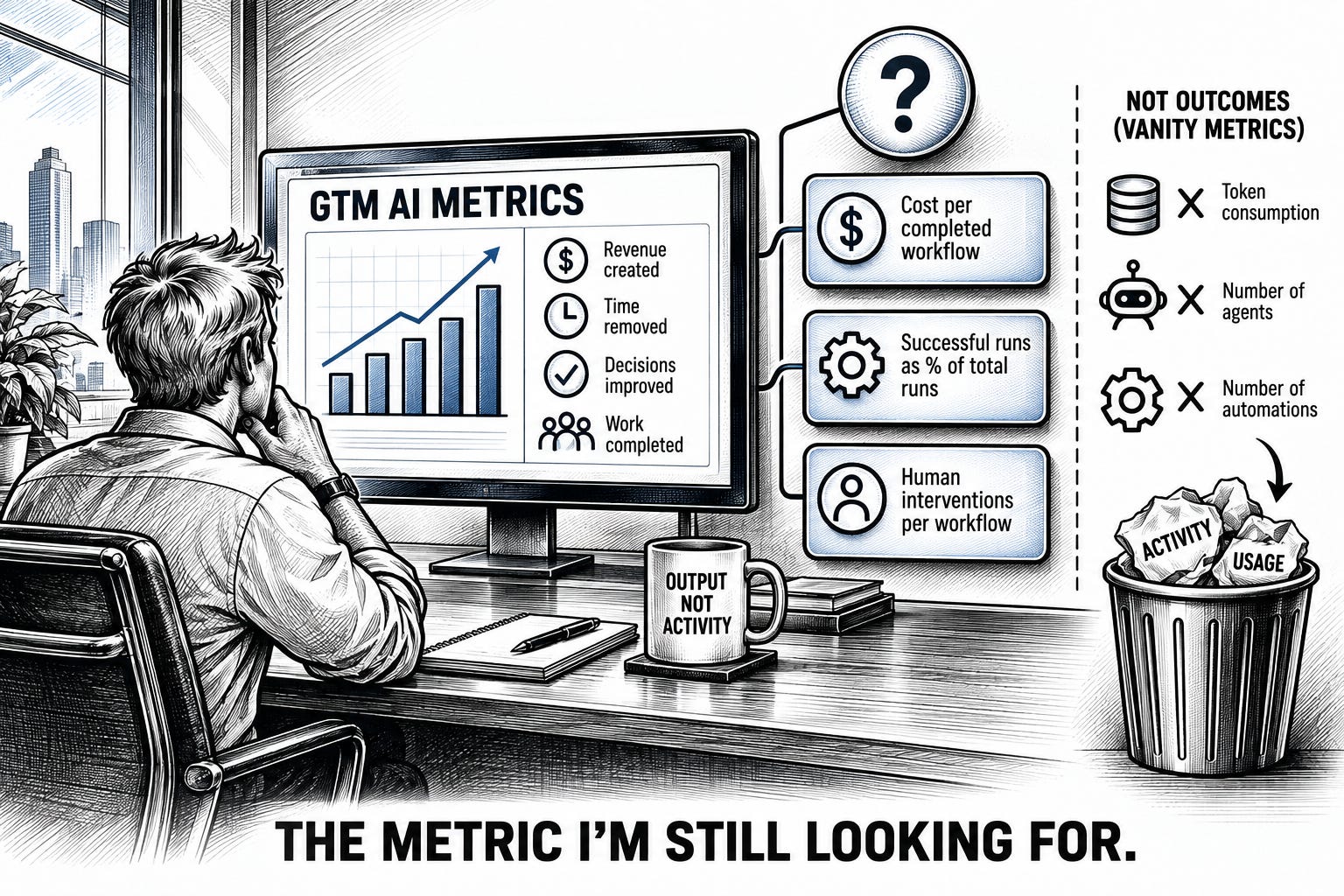
GTM teams running agents need a similar forcing function.
I’m not convinced we’ve found the right one yet.
It might be:
Cost per completed workflow.
Or:
Successful runs as a percentage of total runs.
Or:
Human interventions required per automated workflow.
The important thing is to stop measuring AI activity and start measuring AI reliability and business output.
Token consumption isn’t an outcome.
Number of agents isn’t an outcome.
Number of automations isn’t an outcome.
Revenue created, time removed, decisions improved, and work completed are outcomes.
What changed once I looked
The audit didn’t fix anything.
It did something more useful first.
It turned seven vague anxieties into seven concrete operating decisions.
Permissions became policy instead of fear.
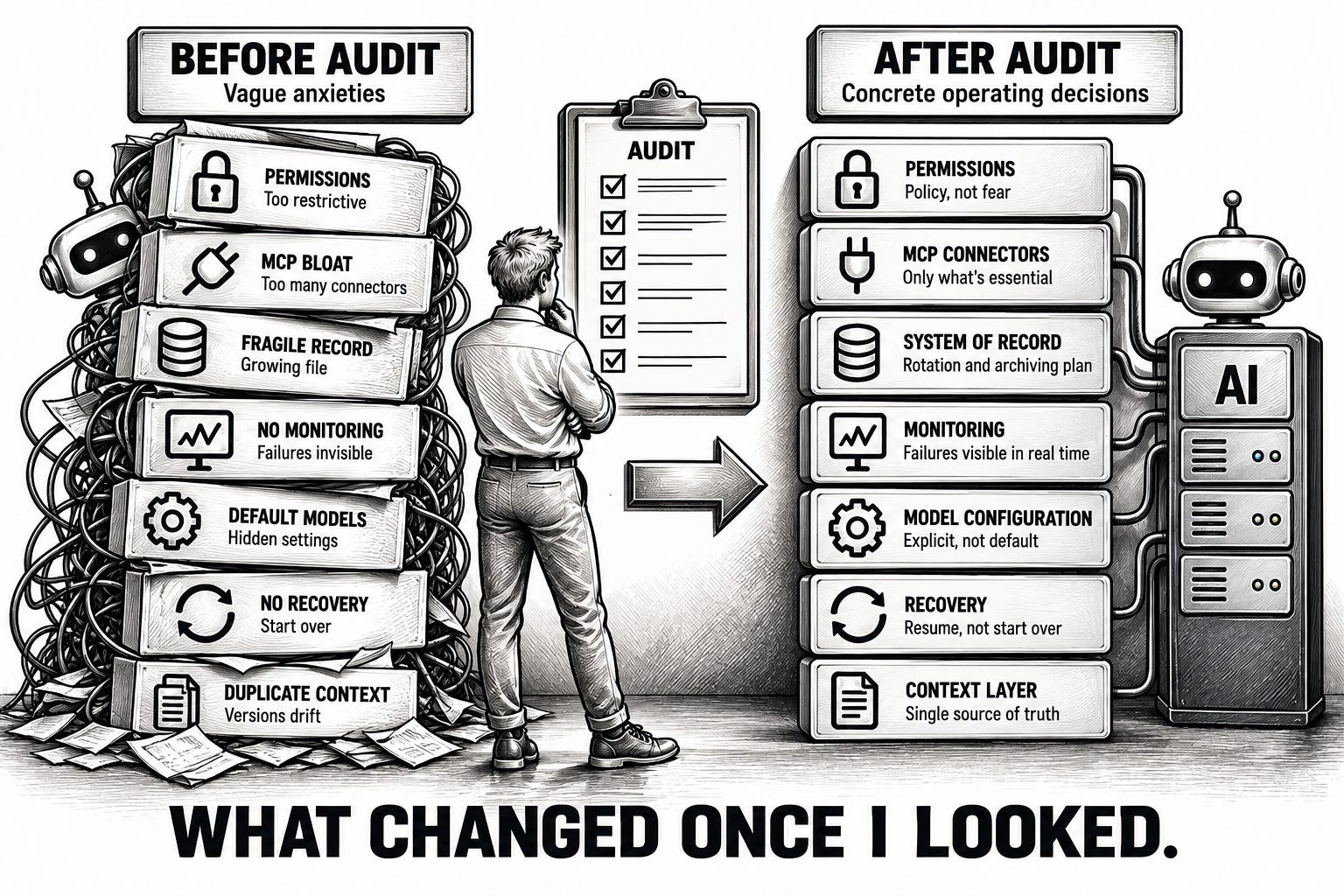
The MCP list got cut back to the connectors that were actually load-bearing.
The registry file got a rotation and archiving plan before it became a recovery problem.
Monitoring got added so a failed workflow becomes visible when it fails, not when someone notices the missing output.
Model choices became explicit configuration instead of hidden defaults.
Failed runs got a recovery path.
And the context layer moved toward one source of truth, with other systems pointing back to it instead of quietly creating competing versions.
None of this is glamorous.
It’s plumbing.
But plumbing is what determines whether “AI orchestration” becomes infrastructure you can trust or a compelling demo that works until the day it doesn’t.
Run your own audit
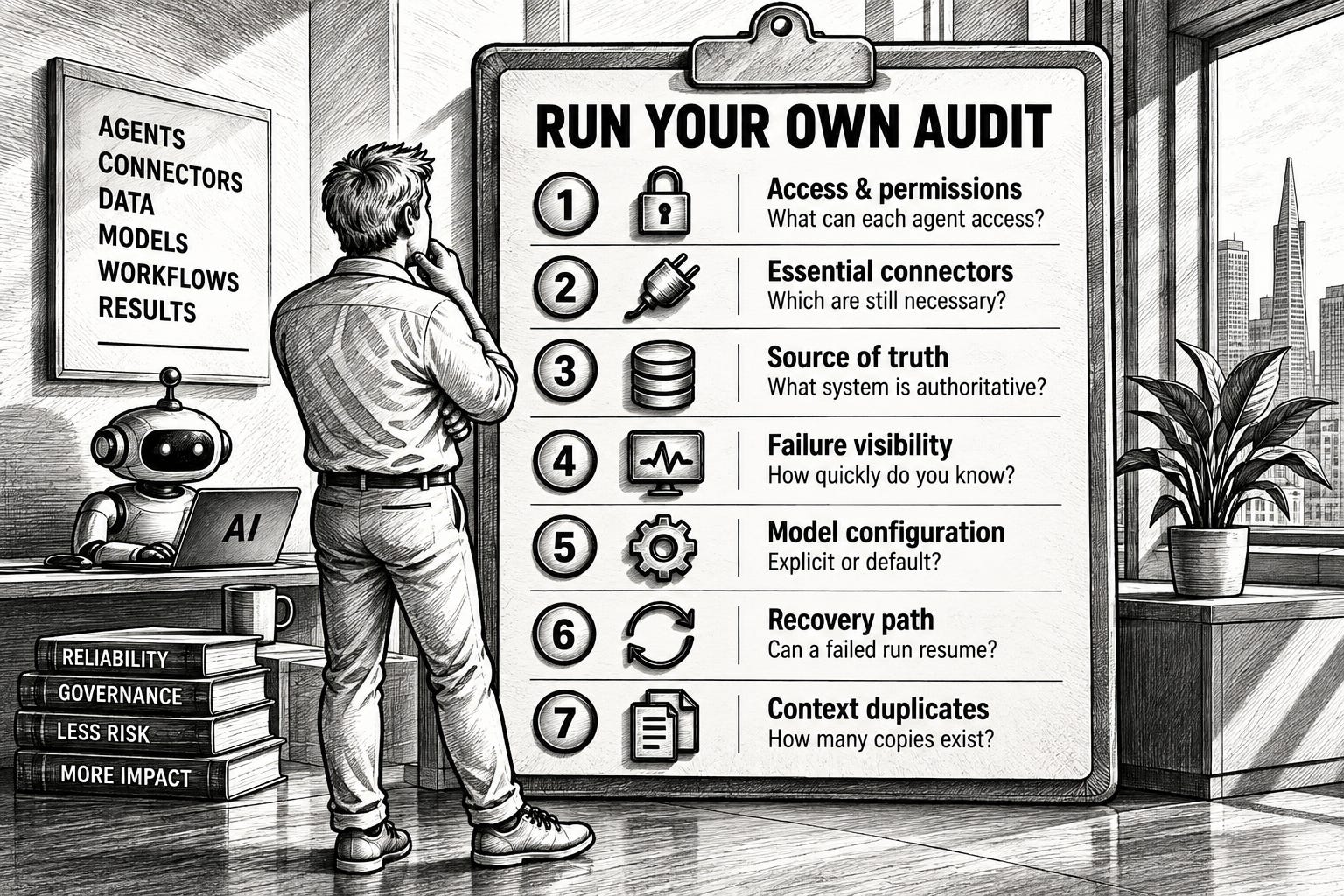
If agents are operating anywhere inside your GTM system, ask seven questions:
What can each agent access, and why?
Which connectors are actually still necessary?
What system is the source of truth?
How quickly do you know when a workflow fails?
Are model choices explicit or inherited from defaults?
Can a failed run recover without starting over?
How many copies of the same context exist across your stack?
If you haven’t looked at those questions in the last 90 days, your AI stack probably contains more infrastructure debt than you think.
Mine did.
And that’s the larger lesson.
The first generation of agentic GTM was about proving that agents could do the work.
The next generation will be about proving that we can operate them reliably.
What’s the part of your own AI stack you’re least excited to audit?
Reply and tell me.
I’ll take the most common answer and dig into it next.