


AI is making execution abundant. That does not make strategy less important. It makes bad strategy scale faster.
I’ve spent the last few weeks in rooms where that sentence stops being a clever line and starts being a budget conversation.

By the way, thank you for reading my blog. Appreciate your engagement.
What the rooms actually sound like
Venture Dock in Palo Alto. Shack15 at the Ferry Building, in the same room as Author of “AI Leadership in the 4th Industrial Revolution”, Kent Kaufman, and Managing Partner at Human Ventures, Manoj Fernando, Apache Iceberg experts from Datadog, Databricks, TRM, and a dozen startups nobody has heard of yet.
"With intelligent robots the paradigm is shifted, and so we may see an acceleration in the ability of robots, and that's why physical AI is such a hot topic at the moment, is because we have not had the ability to have intelligent robots before, and that's a significant change." ~ Kent Kaufman


A session on marketing agents in production with Anthropic.
Workshops on high-ticket sales. Claude Code running outbound through Smartlead and GetLeads. This week, Advancing AI at Moscone.
Here is what struck me. The infrastructure conversation and the go-to-market conversation have stopped being separate conversations.
The people building the models and the people trying to hit a number are now describing the same problem in different vocabularies.

The Unbridled Part
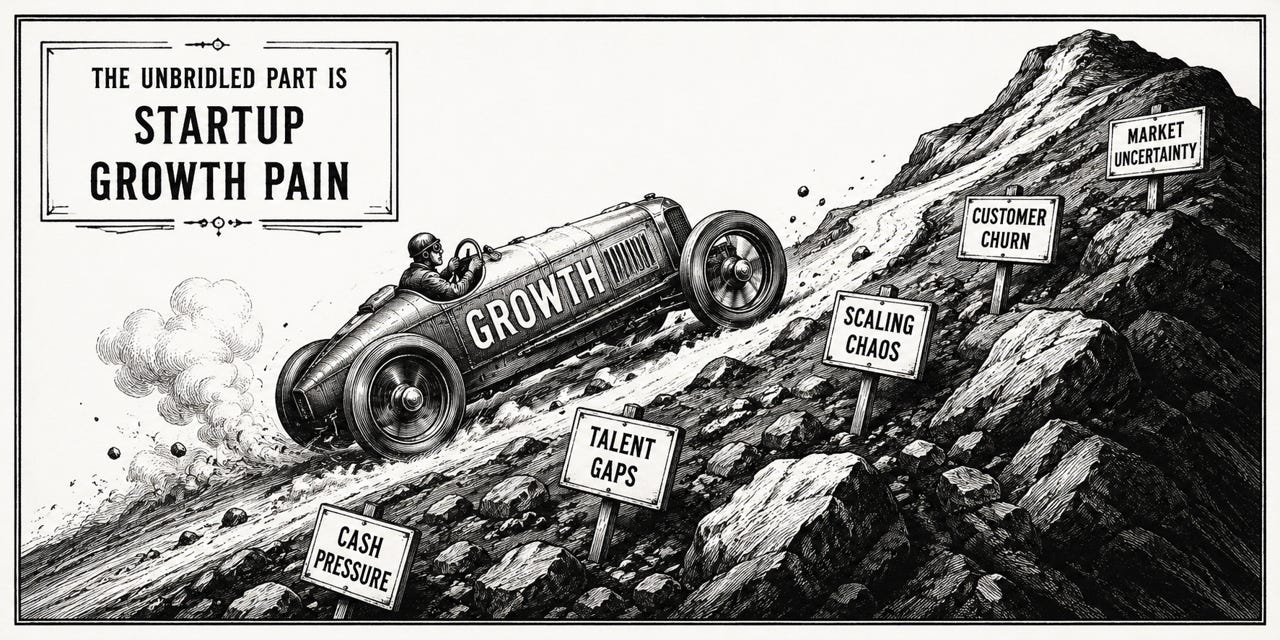
Startup growth pain used to be a capacity problem. Not enough hands.
Now it’s a discernment problem. Too many things you could automate, and no principled way to decide which ones you should.
I sat with technical founders to pressure-test a developer product thesis. I sat with a sales AE to hear where the theory breaks against a real quota.
Same gap in both conversations. Everyone can build. Almost nobody has decided what winning looks like before they build it.
That’s the unbridled part. Not the technology. The absence of a governing question.
What I’m building, in the open
I’m designing a scalable agentic system with hot-swappable data sources. Concretely, it does this:
Reads intent signals. Scores ICP match. Enriches, dedupes, and curates account and contact data. Provides source attribution back to the systems of record. Compounds what it learns about preferences. And gates one segment of the interaction behind a human checkpoint.
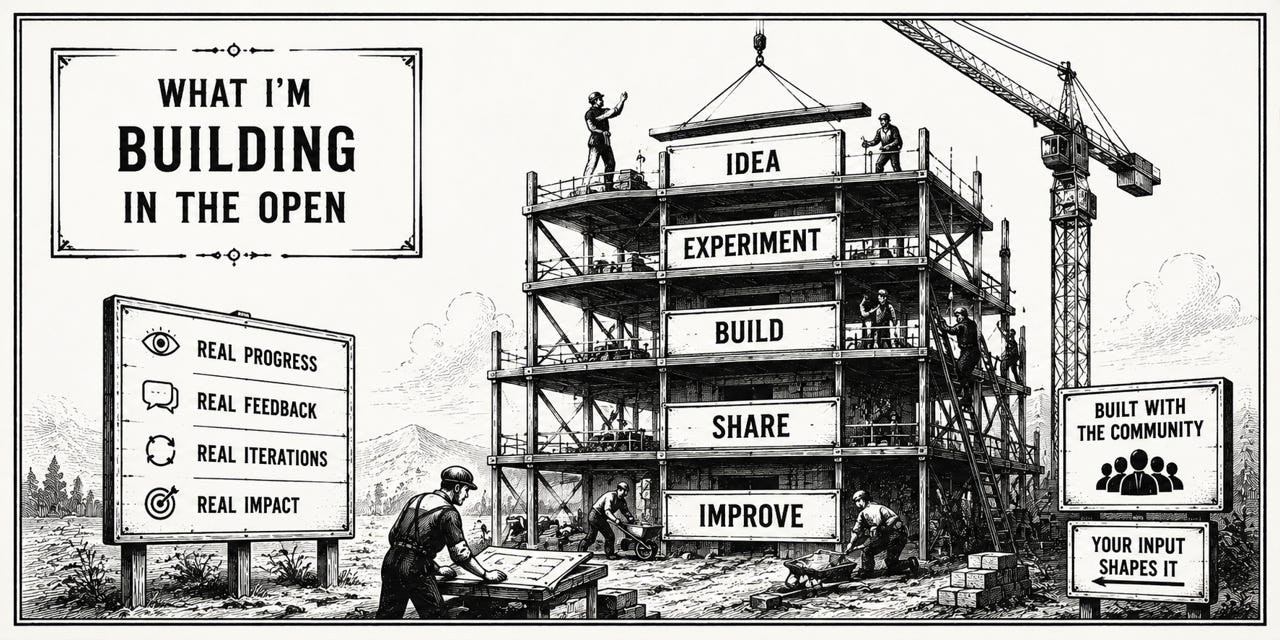
That last one is the part people skip.
Notice the shape. Signal, then Research, then Outreach, then RevOps. That order is not decoration. Reverse it and you get a very fast machine producing very confident garbage.
The four questions I now run everything through
Before I automate anything, it has to survive four questions. If a workflow can’t clear all four, it’s a demo, not a system.
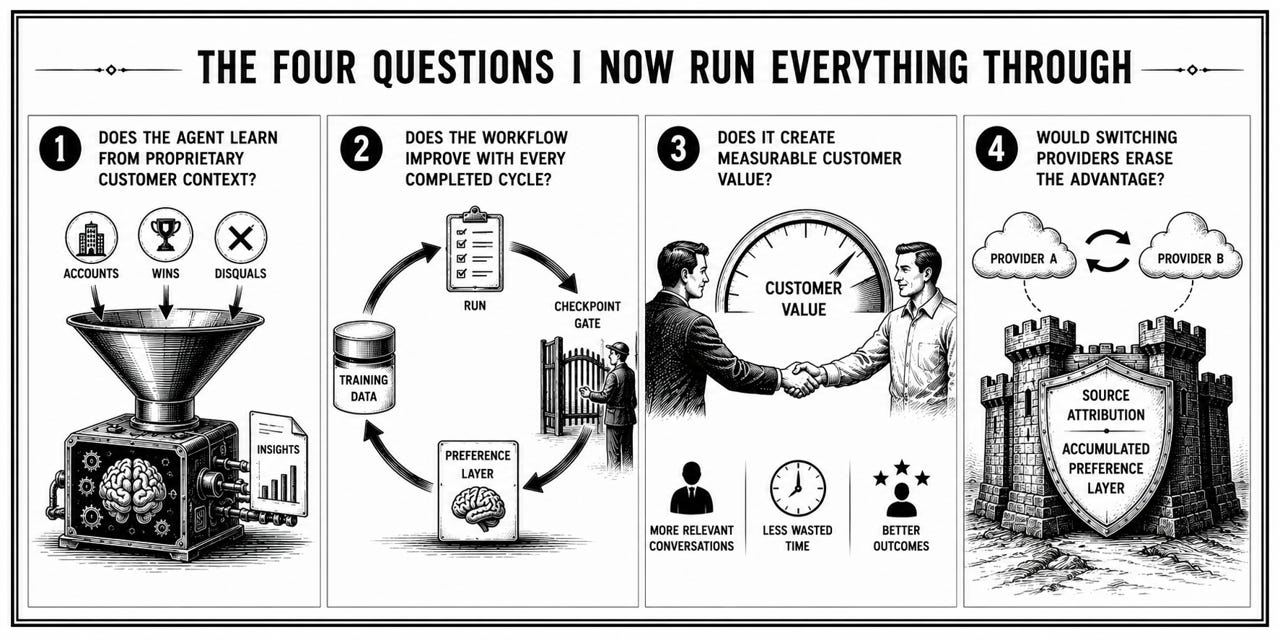
1. Does the agent learn from proprietary customer context?
Generic context produces generic output. My scoring model is only worth something because it’s absorbing signals from my accounts, my closed-won patterns, my disqualifications. The enrichment layer is a commodity. What I feed it is not.
2. Does the workflow improve with every completed cycle?
A workflow that performs identically on run 500 as it did on run 5 isn’t compounding. It’s just fast. The preference layer exists so that every human correction at the checkpoint gate becomes training data for the next cycle. That’s the difference between automation and leverage.
3. Does it create measurable customer value?
Not internal efficiency. Customer value. Did the buyer get a more relevant conversation? Did they waste less time? If the only metric that moved is “emails sent per rep,” you built a spam cannon with a nicer UI.
4. Would switching providers erase the advantage?
This is the brutal one. If swapping the underlying model or the data vendor deletes your moat, you never had a moat. You had a subscription. Source attribution and the accumulated preference layer are what survive a provider swap. The prompts are not.
Three disciplines that didn’t exist on the org chart 18 months ago
Watching adoption patterns across these rooms, a shape keeps repeating. Agent adoption is creating three new executive disciplines. Most people are filing them all under “governance,” which flattens something important.
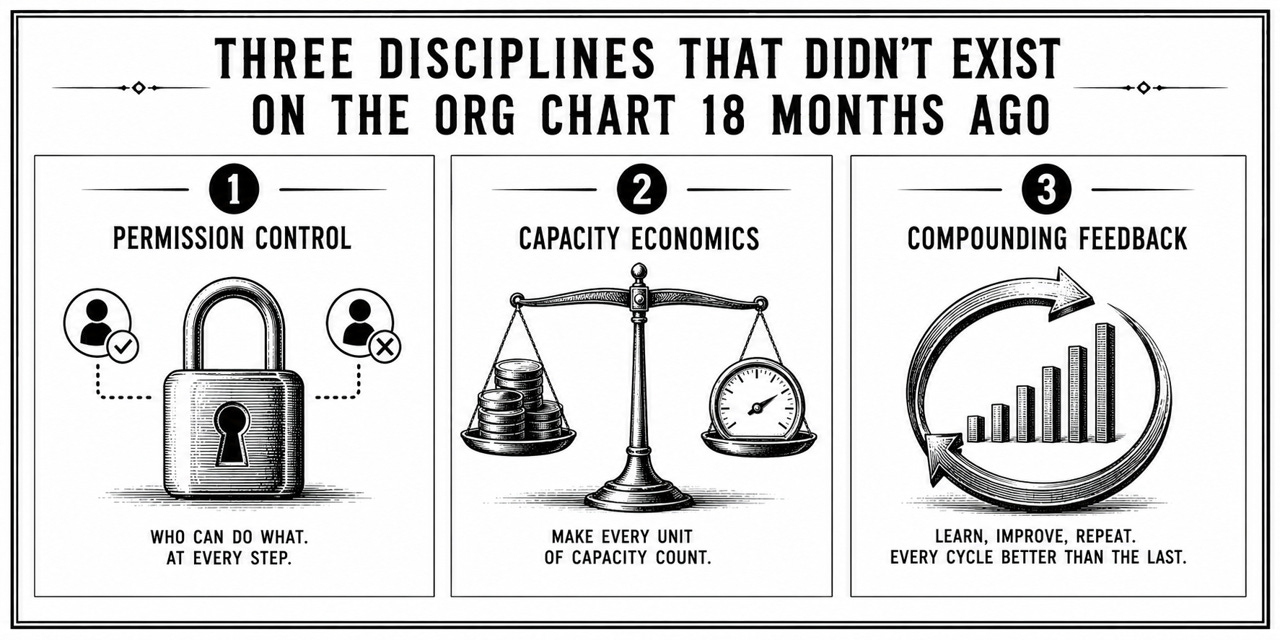
Permission control. What is the agent allowed to touch, on whose behalf, and where does a human have to sign. Not a security checkbox. A design constraint that shapes the whole architecture.
Capacity economics. Inference has a unit cost. Multi-agent orchestration has a unit cost. The question “can we afford to run this 40,000 times a month” is now a strategy question, not an IT question.
Capacity economics. The only defensible proof that any of it worked.
If you can name who owns each of those three at your company, you’re ahead of most of the room.
The economics finally moved
Here’s what changed, practically. Multi-agent orchestration became economically viable.
We’re moving on from one oversized assistant attempting everything. A single model doing signal detection, research synthesis, copywriting, and CRM hygiene was always a compromise. It was just the only affordable option.
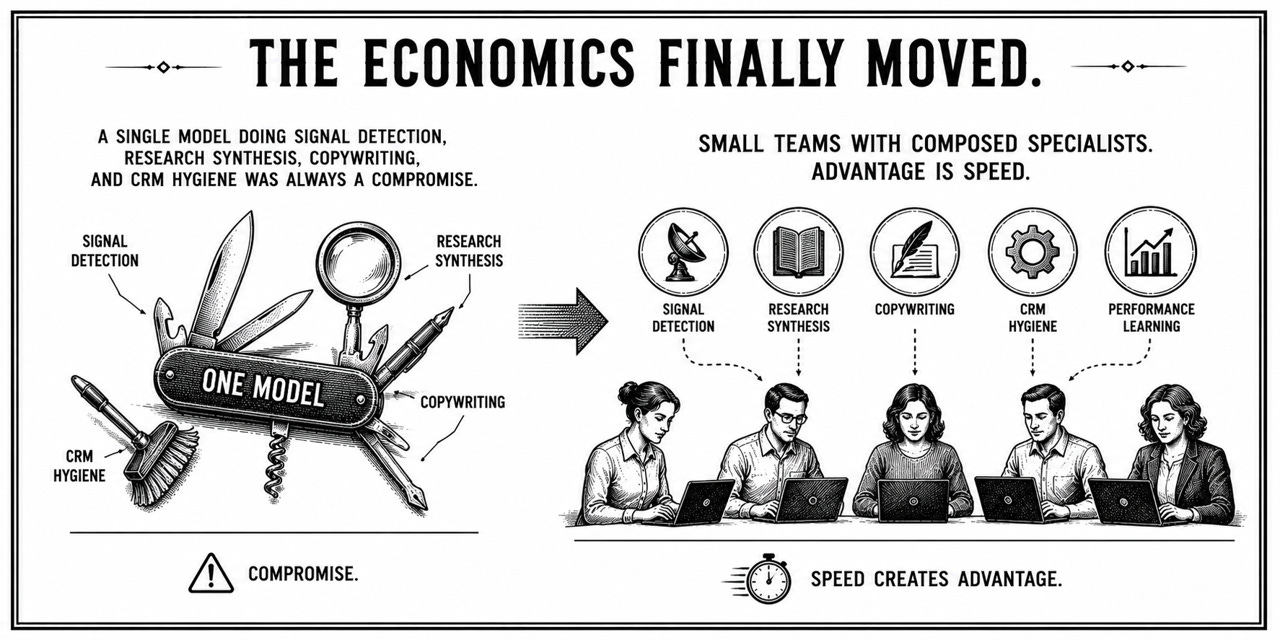
Now you can compose specialists. Small teams can appear much bigger than they are.
But be honest about the other side of that. Your competitors have access to the same models, the same vendors, the same tutorials.
Which means the advantage is not the capability. It’s the speed of your compounding loop and the quality of your judgment about where humans stay in it.
The Honest Tension
I’ll name the pro and the con, because I don’t trust arguments that only have one side.
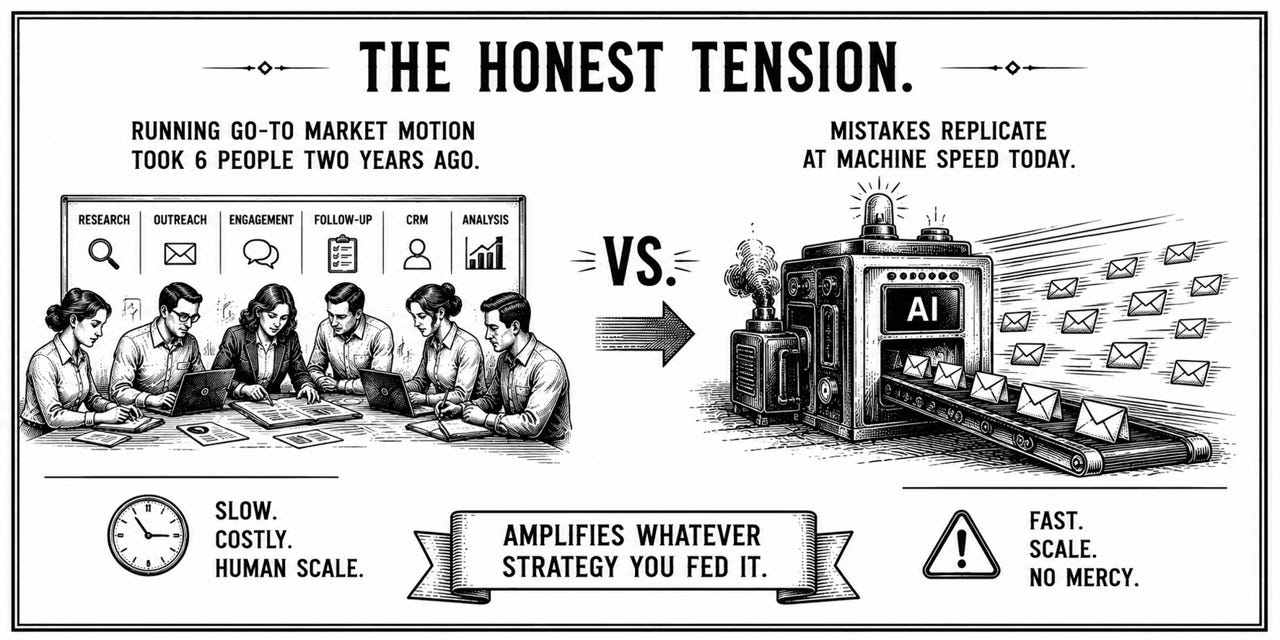
The pro: I can now run a go-to-market motion that would have required six people two years ago, and it gets sharper every week.
The con: the same abundance means my mistakes replicate at machine speed. A wrong ICP definition used to cost me a few bad meetings. Now it costs me 4,000 bad touches and a burned domain reputation.
Execution abundance is amplification. It amplifies whatever strategy you fed it.
Where this Leaves the Discipline
The new GTM discipline is not prompt engineering.
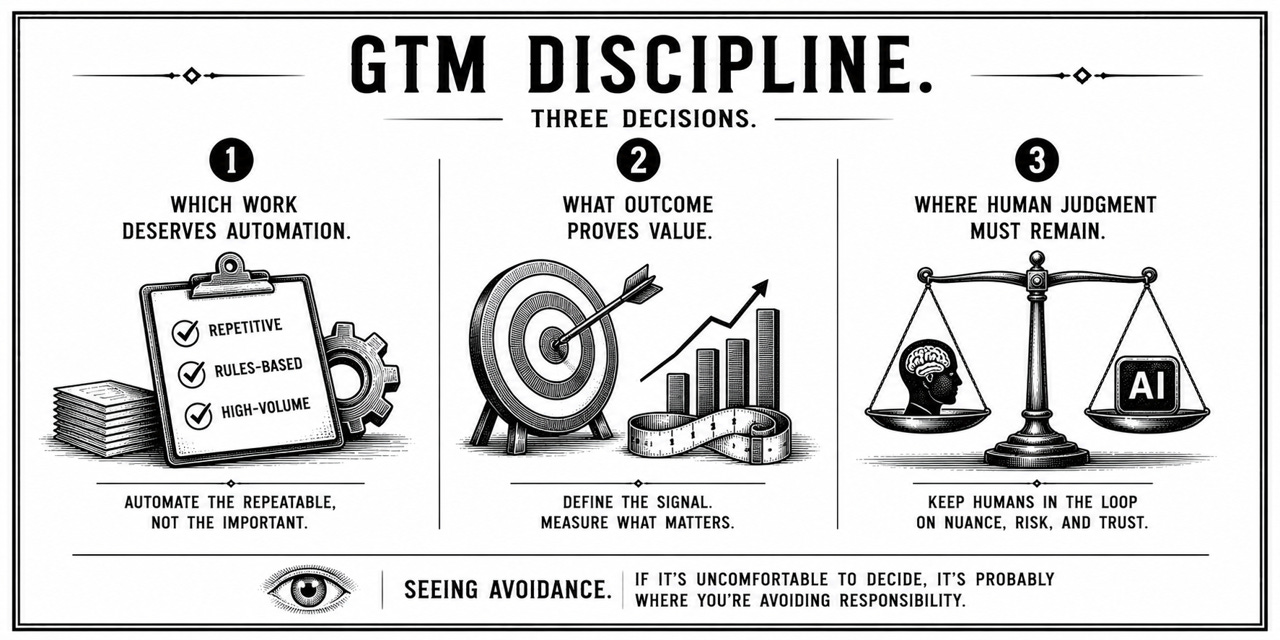
It’s three decisions, made deliberately, in this order:
Which work deserves automation. What outcome proves value. Where human judgment must remain.
That third one is where I see the most avoidance. Teams treat the human checkpoint as a temporary crutch to be removed once the model gets good enough.
I think that’s backwards. The checkpoint is where the proprietary learning enters the system. Remove it and you’ve optimized away the exact mechanism that makes you different from everyone running the same stack.
Build the loop. Guard the gate. Measure the customer, not the activity
What’s the one workflow you’ve automated that you can honestly say passes all four questions? Reply and tell me. I’ll share what I’m learning as this system goes from working to compounding.