


I used to think the hardest part of selling was getting attention.
Now I realize the harder part is keeping the story intact as it passes through a buying group.
Most teams still sell like one good champion is enough. It is not. In 2026, even a mid-market deal touches product, finance, security, legal, RevOps, and executive judgment before it closes. The rep who wins is not the one with the best pitch. It is the one who can carry one coherent narrative across many voices.
That is what multi-threaded messaging actually means. And most teams are still getting it wrong.
The real product I’m selling
Here is the honest reframe. I am not selling “sales enablement” or “professional services” or “a SaaS platform.”
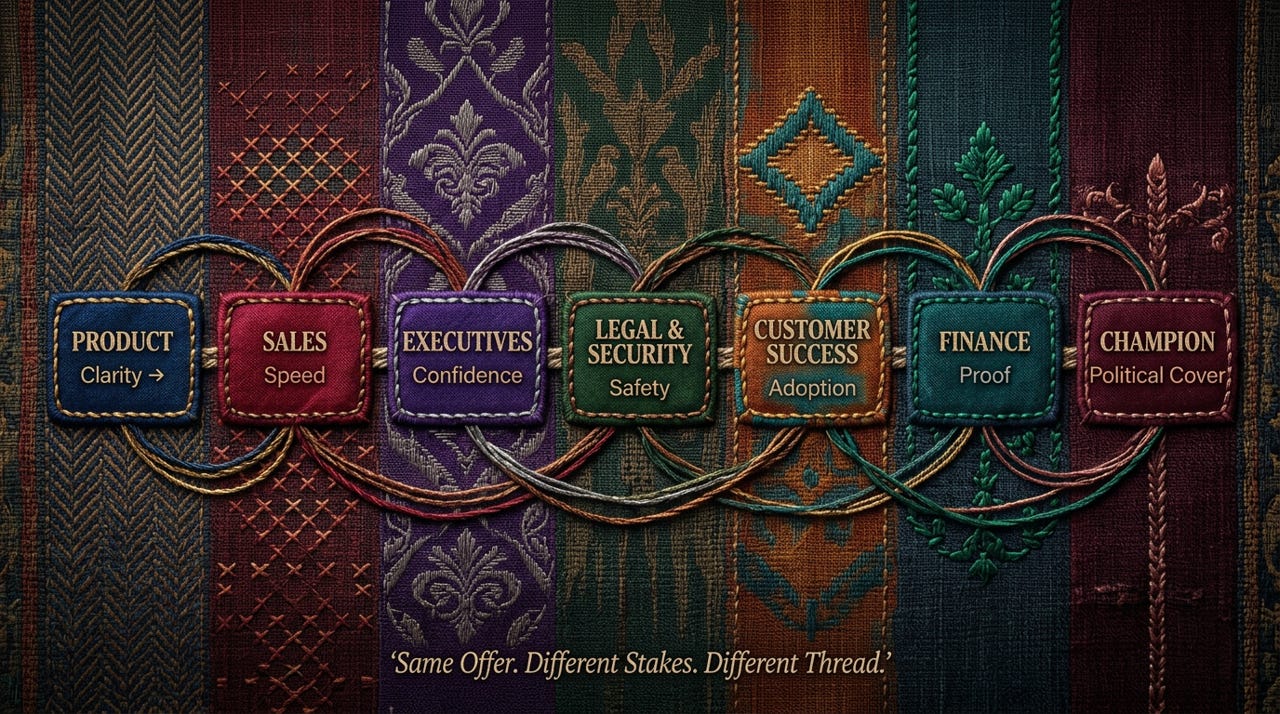
I am selling clarity to product. Speed to sales. Confidence to executives. Safety to legal and security. Adoption to customer success. Proof to finance. And political cover to the champion.
The buyer does not experience my offer as one thing. Each stakeholder experiences it as a different kind of risk reduction.
Same offer. Different stakes. Different thread.
Signal before messaging
Before I write better messaging, I need better signal.
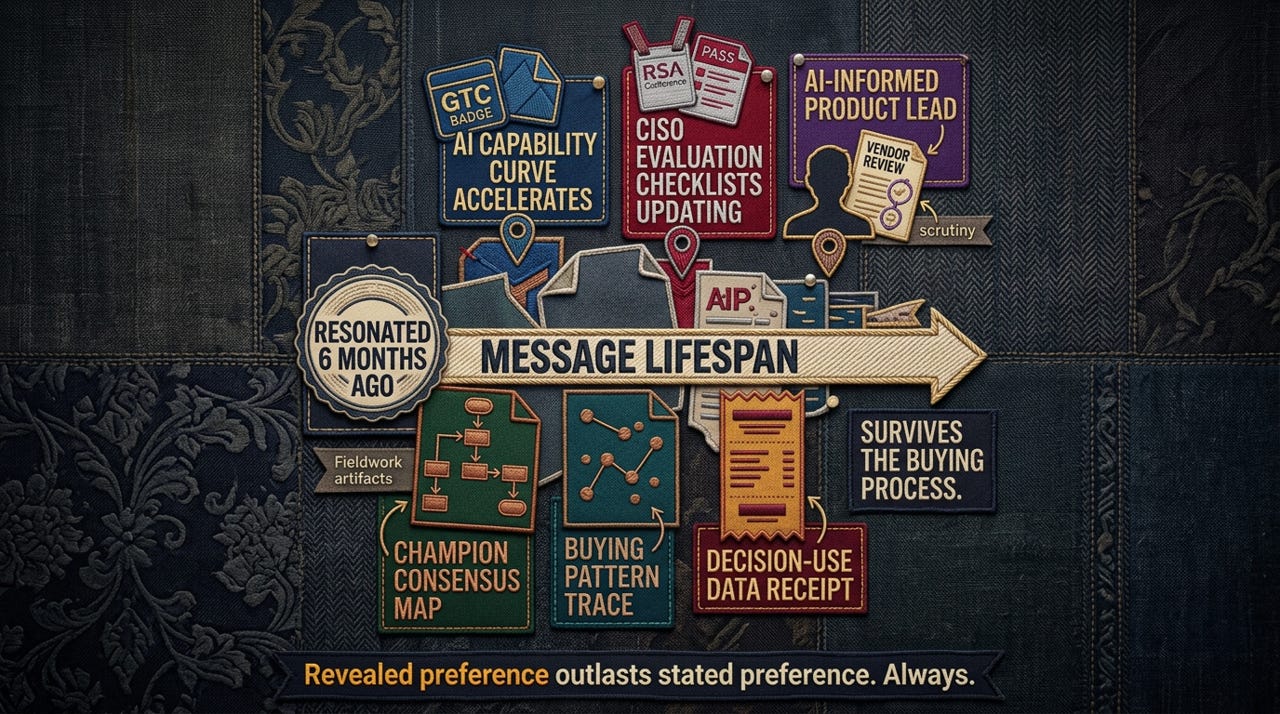
A field sales engineer I respect put it this way: do not ask buyers what messaging they want. Watch how your best customers actually bought. Observe how champions build internal consensus. Look at what information people actually use when they decide.
Stated preference gives you opinions. Revealed preference gives you the message that survives the buying process.
This matters more right now than ever. At GTC recently, Nvidia and its ecosystem partners are accelerating the AI capability curve for every technical buyer in the room. Security leaders gathering at RSA in San Francisco are updating their vendor evaluation checklists in real time. Your buyers are not static. Their mental models are shifting fast. The message that resonated six months ago may not survive the scrutiny of a newly AI-informed product lead or a freshly alerted CISO evaluating a risk issue or a vendor review today.
Do not automate a broken sales motion. Understand it first.
The Five-stage Buyer Journey, compressed
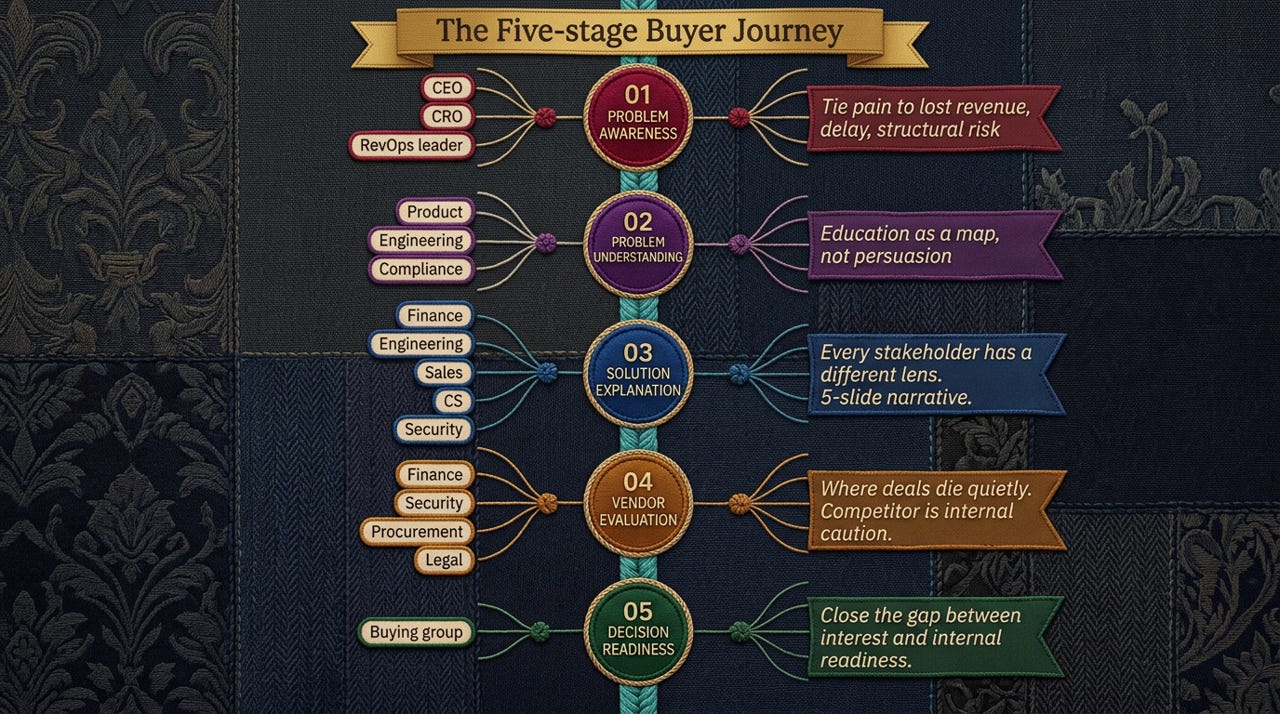
Let me walk through the buying journey with one goal: show you who matters most at each stage and what they need to hear.
Stage 1 — Problem Awareness. A trigger fires. A missed number. A board question. A churn spike. At this stage I am not selling a solution. I am helping the buying team agree the problem is real. The CEO, CRO, and RevOps leader are most active. Tie the pain to lost revenue, delay, or structural risk. Not features.
Stage 2 — Problem Understanding. The buyer starts due diligence. Product, engineering, and sometimes compliance begin hovering. This is where education becomes a sales tool. The best multi-threaded messaging at this stage feels less like persuasion and more like a map.
Stage 3 — Solution Explanation. The buyer shifts from “what is wrong?” to “how could we fix it?” Every stakeholder has a different lens. Finance wants payback. Engineering wants integration clarity. Sales wants conversion lift. CS wants adoption speed. Security wants controls. This is the point where a five-slide narrative beats a forty-minute product rabbit hole.
Stage 4 — Vendor Evaluation. Finance, procurement, security, and legal arrive with full authority. This is where deals die quietly. The competitor is not always another vendor. Sometimes the competitor is internal caution.
Stage 5 — Decision Readiness. The buying group is close, but still needs political cover, timing, and internal consensus. Deals are not lost only on objections. They are lost in the gap between interest and internal readiness.
Three entry motions, same buying group
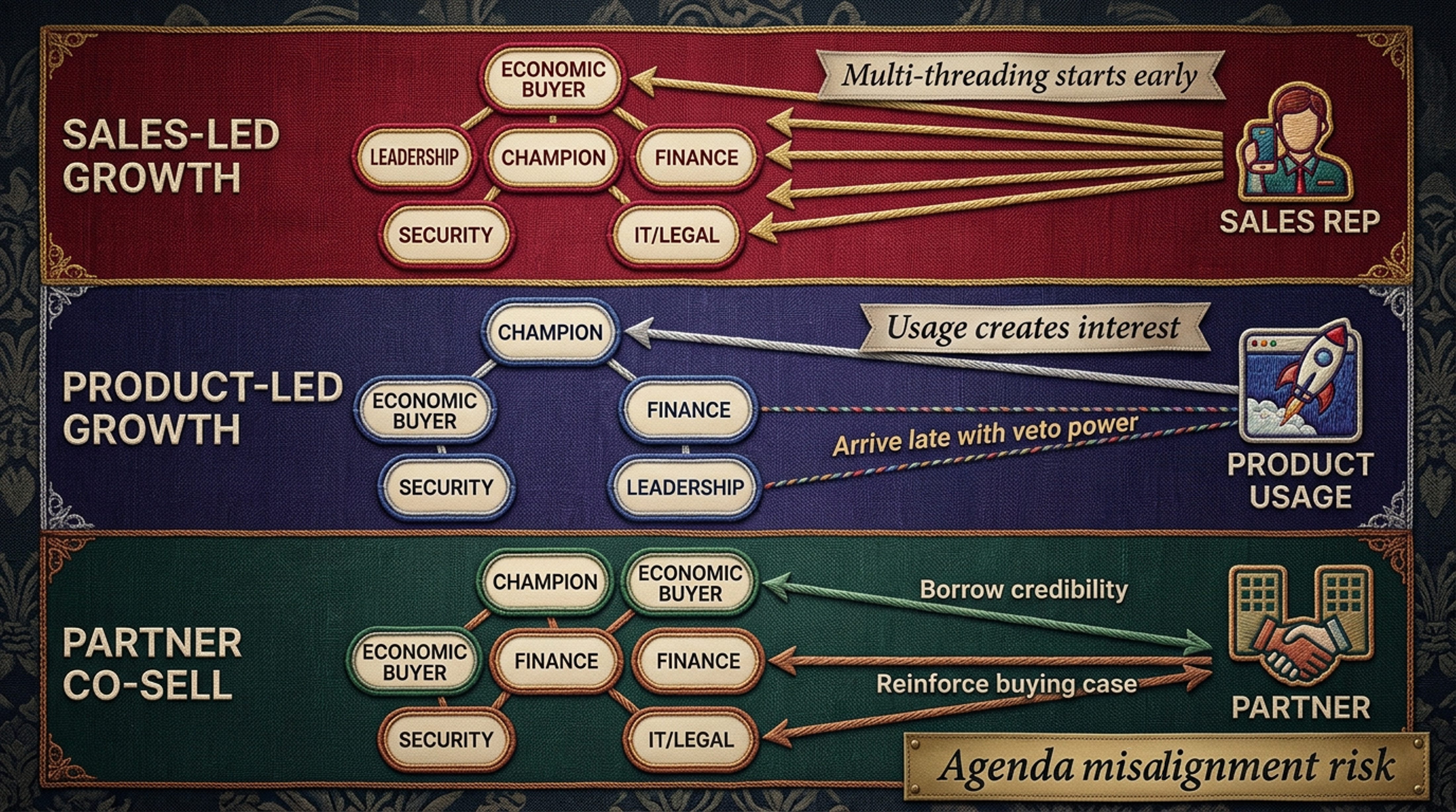
Whether you are running sales-led, product-led, or a partner co-sell, the buying committee does not change. What changes are when you enter and how much trust you start with.
In sales-led growth, multi-threading starts earlier because trust starts lower. In product-led growth, usage creates interest. It does not replace committee alignment. Too many PLG teams mistake product engagement for buying consensus. Finance, security, and leadership often arrive late and cold with real veto power.
In partner co-sell, you borrow credibility, but you also inherit agenda misalignment. A partner co-sell works best when the partner is not just opening the door, but reinforcing the same buying case each stakeholder needs to hear.
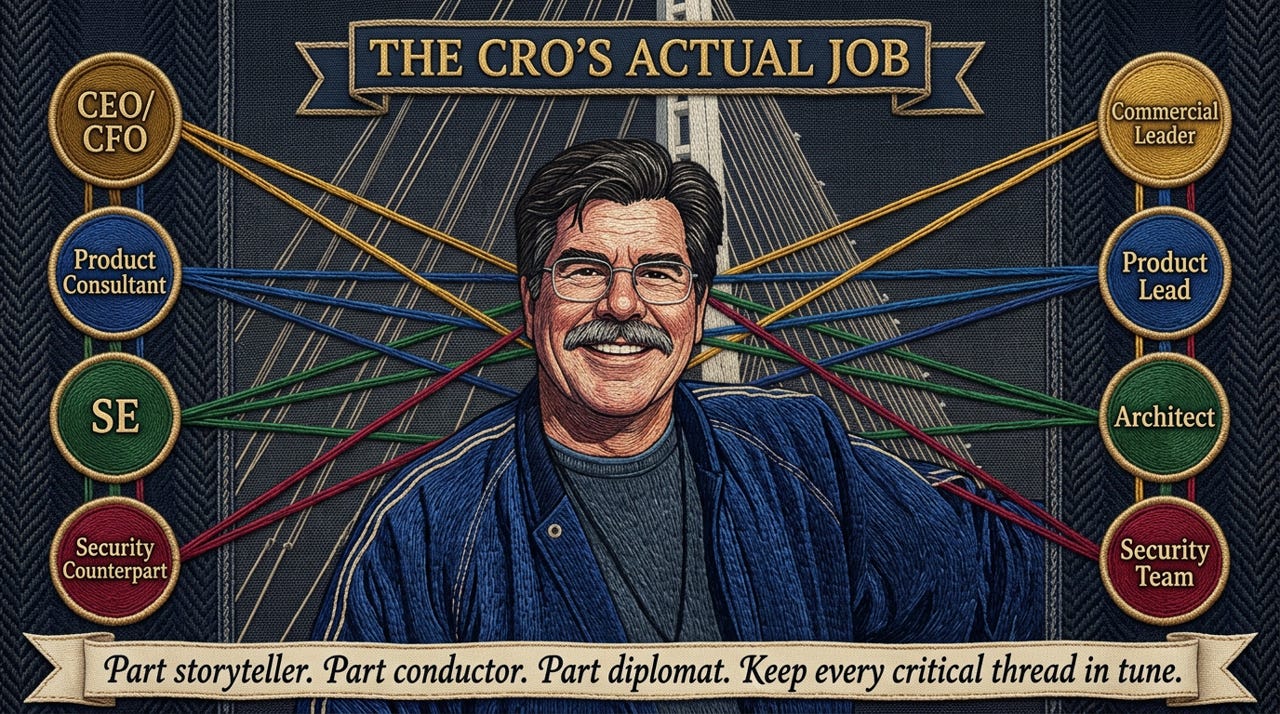
The CRO’s actual job
The CRO is not just managing reps. They are coordinating specialist-to-specialist credibility across both sides of the table.
Your CEO and CFO should map to their commercial leader. Your product consultant should map to their product lead. Your SE should map to their architect. Your security counterpart should meet theirs before the deal stalls in a questionnaire.
The modern CRO is part storyteller, part conductor, part diplomat. The job is not to push one message harder. It is to keep every critical thread in place.
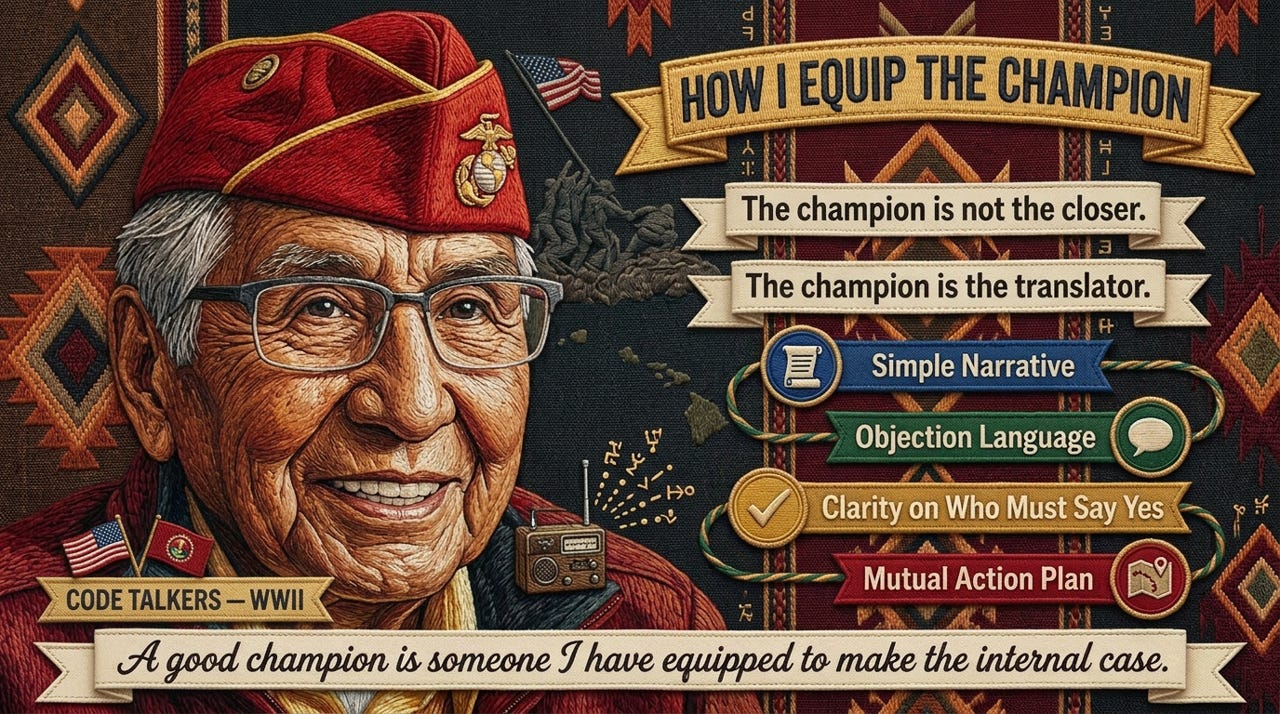
How I equip the champion
The champion is not the closer. The champion is the translator.
My job is to make them look smart when I am not in the room. That means a simple narrative, not a feature deck. Objection language they can actually use. Clarity on who must say yes. A mutual action plan they can execute without me coaching every step.
A good champion is not someone who loves my pitch. A good champion is someone I have equipped to make the internal case.
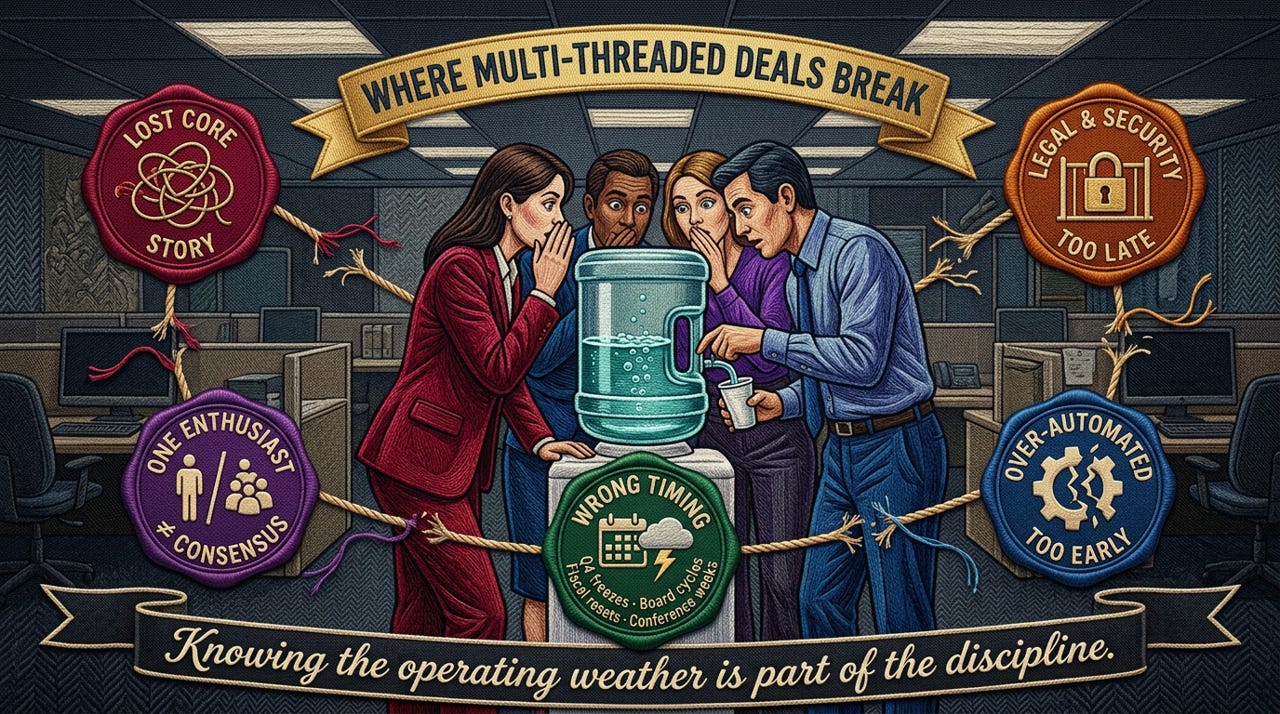
Where multi-threaded deals break
I see a few patterns consistently. Messaging each persona differently but losing the core story in the process. Bringing security and legal in too late. Letting one enthusiastic stakeholder substitute for committee consensus. Over-automating before the motion is actually understood.
Add timing to the list. Conference weeks, fiscal resets, Q4 freezes, and board cycles all affect when buying groups can actually move. Knowing the operating weather is part of discipline.
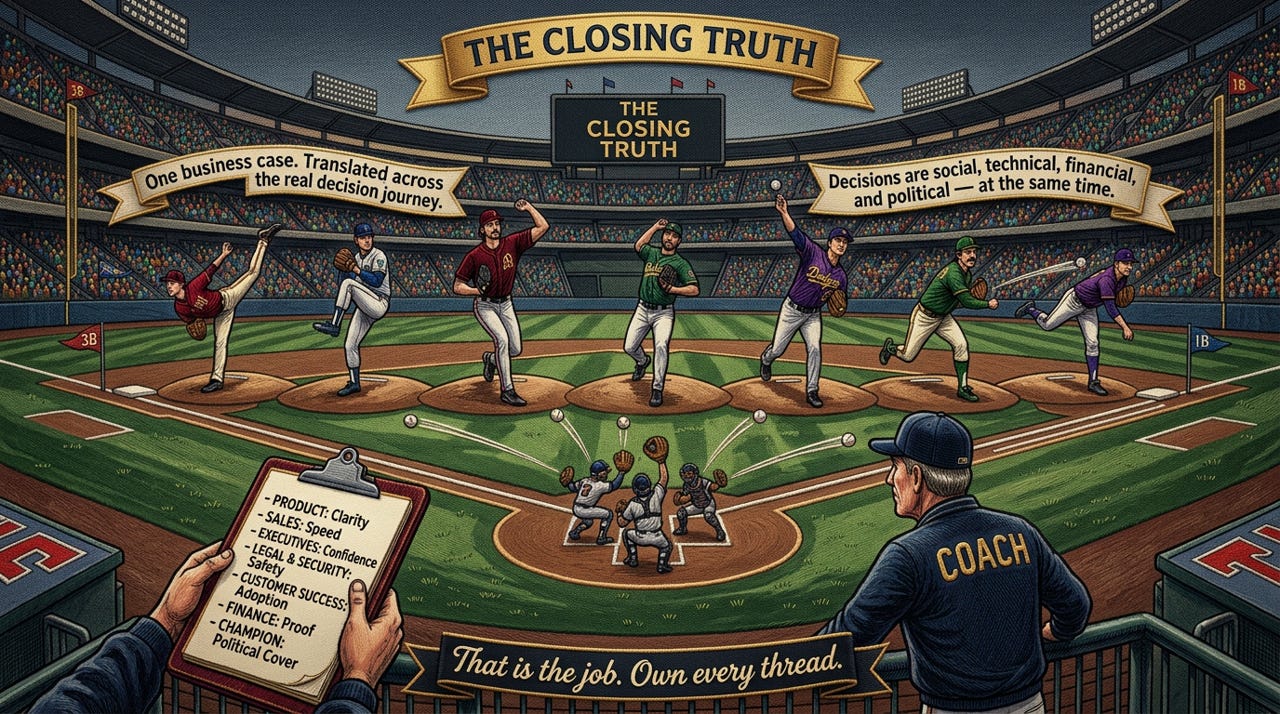
The closing truth
Multi-threaded messaging is not seven different pitches.
It is one business case, translated across the real decision journey.
The old GTM model assumed a lead could become a deal if the rep worked hard enough. The modern model is different. A deal becomes real only when the buying group can move together. That is why this discipline matters. Not because buying committees are trendy. Because decisions are now social, technical, financial, and political at the same time.
That is the job. Own every thread.
Which stakeholder unravels more deals in your world: finance, security, or indecision? Drop it in the comments.