

Your SDR team is counting touches. Your buyers are counting hours.
One of those numbers closes deals. The other fills a dashboard nobody trusts.

Here’s the operating truth most GTM teams won’t say out loud: 28 touches into silence isn’t persistence. It’s a signal you never earned the first hour.
The Research Has Already Happened
By the time your sequence fires, your buyer has done 80% of their research. They’ve been on podcasts, Reddit threads, YouTube, and AI queries. They’ve formed a view of you — or they haven’t.

You’re not the first voice in the room. You’re competing with the impression left by every hour of content they consumed before your name landed in their inbox.
Two patterns show up everywhere right now.
The founder with 200 leads and 3 conversions. The list isn’t cold. The brand isn’t warm enough. You’re asking for time you haven’t earned.
The CRO with SDRs at 120% of activity quota and 60% of pipeline target. Activity without presence is noise. You’re measuring the wrong variable.
Both problems look like a pipeline problem. Neither one is.
The 7-Hour Threshold
There’s a principle behind the highest-converting GTM programs I’ve seen. It’s not a sequence. It’s a threshold.
Seven hours of content consumption is a buying signal. More predictive than a form fill. More reliable than a demo request.

Think about it this way: you don’t trust a vendor after one email. You trust one after you’ve spent real time with their thinking. The same is true for your buyers.
Here’s how the framework maps across your GTM stack.
Signal: Stop tracking opens. Track hours.
Most teams run signals on intent to notice. The 7-hour principle runs signals on intent to trust.
Podcast listens. Video watch time. Workshop attendance. Newsletter engagement depth. When a prospect crosses a meaningful consumption threshold, that’s not just activity data. That’s a trust indicator. Build the infrastructure to see it.
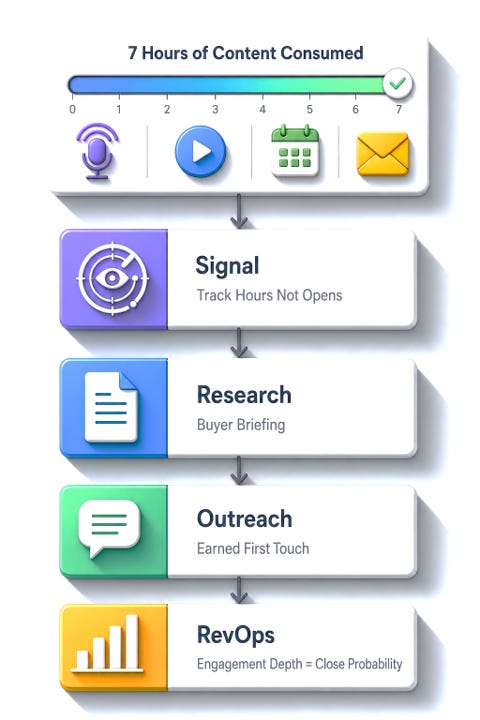
Research: The 7 hours tell you more than the prospect does.
When Signal shows you someone has consumed 7 hours of your content, it also tells you which 7 hours. What topics. What formats. What questions they’re still carrying.
That’s not a lead record. That’s a buyer briefing. Use it to understand exactly what’s still unresolved before you make contact.
Outreach: The first touch should be earned, not claimed.
Outreach triggered by engagement depth converts because it’s contextual. You’re not interrupting. You’re showing up at the moment they’re ready.
That’s the difference between a 28-touch sequence and a single message that books the meeting. One assumes attention. The other earns it.
RevOps: Change the metric.
Not “how many touches did this deal receive?” Ask “how many hours of engagement happened before the first meeting?”
Engagement depth becomes a leading indicator of close probability. It belongs in your forecast model more than activity count does.
When Deals Stall Mid-Funnel

This is where the framework stops being theoretical and becomes operational.
If you’re a founder in a stalled deal:
You’re sending follow-up emails. Checking in. Giving them one more week. Nothing is moving.
Here’s what’s actually happening. They haven’t hit their 7-hour threshold yet. They’re still deciding if they trust you enough to champion this internally.
The fix isn’t more outreach. It’s delivering the next hour of content that advances their confidence. A recorded pitch. A workshop invite. A peer case study that answers the question they haven’t voiced yet.
The Signal layer tells you where they are. Outreach meets them there. That’s the founder-led sales motion that actually works. Not 28 more touches. A system that earns the remaining hours.
If you’re a CRO with a stalled mid-funnel:
Mid-funnel deals stall for three reasons: wrong ICP, wrong champion, or insufficient trust. Most teams treat all three with the same tool. A follow-up sequence.
The deals stalled on trust can’t be re-engaged with volume. They need depth.
Here’s the signal to build into your model: if a prospect is in Stage 2 pipeline and hasn’t logged 3+ hours of brand engagement, that’s not a pipeline problem. It’s a nurture problem wearing a pipeline costume.
Deals where buyers hit 7+ hours of engagement before discovery close faster, with fewer objections, at higher ACVs. That’s a forecast model worth trusting.
What This Looks Like in Practice

A bootstrapped ABM agency founder. One hundred programs built. $130M in pipeline sourced. Two people on the revenue team.
He doesn’t run 28-touch sequences. He runs a 7-hour stack: weekly podcast, weekly newsletter, monthly deep-dive webinar, quarterly in-depth workshop. By the time someone books a call, they’ve already decided. He sends a pre-recorded pitch so they don’t waste a meeting on the overview. Average sales cycle: 58 days, 28 of which are legal review.
That’s not an outlier. That’s what happens when you build a GTM system around earning trust instead of counting activity.
The pipeline fills differently. The conversations open differently. The close rate looks different too.
The Question Worth Asking
What’s your 7-hour stack?
Not your sequence. Not your cadence. Your stack. The body of content and experience that moves a skeptical buyer from “I’ve heard of them” to “I’m ready to talk.”
And do you know if your buyers are spending those hours with you — or with the competitor who figured this out first?
If you’re a CRO or founder and this pattern sounds like your pipeline right now, reply. I want to hear what your 7-hour stack looks like. Or why you don’t have one yet.